
OPTOMAN Uses AI to Remove Friction from a Highly Technical Engineering Conversation
A new AI-powered assistant helps laser engineers provide the right technical information upfront, allowing faster, more focused engineering discussions.
Every custom optics project is different, and the quality of the first conversation has a big impact on how quickly we can find the right solution,
says Lukas Ceizaris, CMO at OPTOMAN.
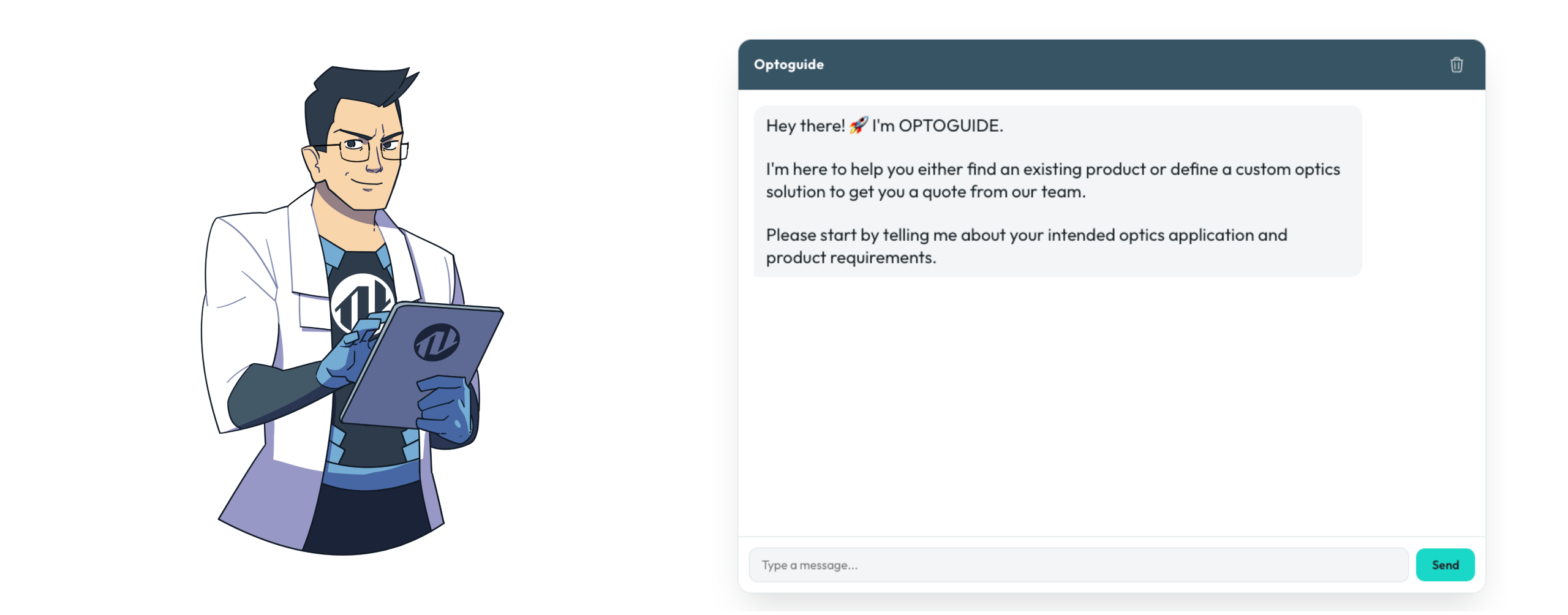
Turning the custom optics request into a meaningful engineering discussion requires many technical details: wavelength, power levels, operating environment, substrate requirements, coating specifications, damage thresholds, and application-specific challenges. Gathering this information can take several rounds of communication before an optics supplier can prepare a suitable solution. To make this process faster and more efficient, OPTOMAN has introduced OptoGuide, an AI-powered technical assistant that helps customers prepare their custom optics requests and provides OPTOMAN’s engineering team with the information needed to start evaluating a project.
OPTOMAN OptoGuide
Unlike general-purpose AI tools, OptoGuide is built specifically around the requirements of high-power laser optics. It guides users through the key technical questions that an optics engineer would typically ask during an initial consultation, from optical parameters and laser conditions to application requirements and performance expectations.
OptoGuide helps customers organize the important details upfront and asks questions that are necessary to answer for highly application-optimized solutions. It helps to reduce the quotation preparation process significantly.
Turning the first inquiry into an engineering conversation
For laser engineers, developing a new optical component is rarely just about selecting a coating or meeting a specification sheet. High-power, ultrafast, UV, and infrared laser systems often involve complex trade-offs between performance, durability, thermal effects, and long-term reliability. OptoGuide is designed to support that early-stage engineering process by helping customers define:
- Laser wavelength and spectral requirements
- Power levels, pulse characteristics, and operating conditions
- Environmental considerations
- Mechanical and integration requirements
- Application-specific challenges that may affect optical performance
Once the information is collected, the OPTOMAN team can review the request with better context and prepare a more relevant technical response.
AI supporting engineers — not replacing engineering expertise
While artificial intelligence is changing how technical teams work, OPTOMAN views AI as a tool to improve collaboration between customers and optical engineers.
Custom optics development is still a conversation between engineers, adds Lukas. OptoGuide does not replace that interaction. It simply helps us get to the valuable part of the conversation faster — understanding the application, discussing challenges, and developing the right optical solution.
With years of combined optical engineering experience and expertise in ion beam sputtering (IBS) coatings, OPTOMAN works with customers developing demanding laser systems across industries including scientific research, fusion energy, semiconductor manufacturing, medical technology, aerospace, and defense. By combining engineering knowledge with AI-assisted information gathering, OptoGuide aims to make the first step of custom optics development faster, clearer, and more productive for both customers and OPTOMAN’s technical team.
