
Advanced Optics for Directed Energy

The Dawn of Directed Energy Warfare
Directed Energy Weapons (DEW) use concentrated electromagnetic energy to neutralize threats without the need for physical projectiles. These systems primarily leverage high energy laser and high power microwave technologies to deliver force at the speed of light. Advanced optics for directed energy play a crucial role in ensuring these technologies achieve precise targeting and effectiveness. This capability enables precise engagement with minimal collateral damage while addressing the critical operational need for a virtually unlimited magazine capacity and a low cost per engagement. These characteristics make DEWs an ideal solution for countering maneuvering targets in dynamic combat environments.
Interest in directed energy has accelerated in response to evolving threats, particularly the proliferation of unmanned aerial systems.
While microwave systems disrupt electronics over a broad volume, 100-kilowatt (kW) class laser-based systems focus intense optical energy onto a localized target area. Regardless of the specific technology, overall effectiveness depends not only on the power of the source but on how efficiently that energy is transmitted through the internal optical system and the atmosphere. Interest in DEWs has accelerated in response to evolving threats, particularly the proliferation of unmanned aerial vehicles (UAV). Conventional kinetic defenses face limitations in cost, ammunition supply, and collateral damage risk when countering drone or missile swarms. However, as these systems transition from experimental prototypes to operational field assets, it has become clear that mission success is fundamentally determined by the survivability of internal optical components. The performance and endurance of these critical elements are now the primary factors ensuring reliable operation in high stakes defense applications.
Multi-Domain Deployment
As Directed Energy Weapons transition into operational service, their deployment across land, sea, and air platforms reveals that domain differences do not alter the fundamental physics of energy delivery. While each environment imposes unique mechanical stresses and environmental hazards, they all push optical components toward the same critical limits of absorption, thermal stability, and durability. These factors ultimately define the effectiveness and reliability of the entire weapon system, and highlight the importance of advanced optics for directed energy in sustaining performance across platforms.
Land-Based Deployment
Ground-based DEWs are primarily utilized for short-range air defense and counter-UAV missions. Vehicle-mounted lasers protect maneuver units, fixed sites, and critical infrastructure, prioritizing rapid target acquisition, repeatable firing, and sustained operation over single-shot peak performance. On land, optics must survive exceptionally rugged conditions, including heavy dust and sand contamination, intense mechanical shock, and constant vibration. These systems also face extreme temperature cycling and limited opportunities for field maintenance. As the threat of low-cost drone swarms grows, land-based systems will require higher power outputs and longer duty cycles. This evolution increases the performance requirements for internal laser optics and external protective windows, which must withstand both high-energy beams and environmental abrasion.
Maritime Deployment
Naval platforms are among the earliest operational users of high-energy lasers, targeting UAVs, small surface craft, and surveillance sensors. Ships can supply more power than land vehicles, but optics face constant salt spray, humidity, and vibration. Water vapor and marine aerosols significantly increase atmospheric losses and heighten the system’s sensitivity to internal absorption. In this corrosive setting, even minor coating instabilities can lead to thermal runaway and surface degradation. Therefore, optical durability and chemical resistance are the key factors for ensuring that maritime DEWs remain mission-ready during long deployments at sea, where advanced optics for directed energy must maintain stability under continuous environmental stress.
Airborne Deployment
Airborne DEWs operate under the most stringent size, weight, and power (SWaP) constraints. These systems must function reliably while subjected to high G-forces, intense vibration, and rapid temperature fluctuations during altitude changes. Because engagement windows are often short and pointing accuracy is critical, the optics must maintain absolute spectral and mechanical stability during aggressive maneuvers. Airborne integration highlights how quickly mechanical stress and thermal cycling can degrade beam quality. The lessons learned from high altitude operations are increasingly informing the design of land and naval systems, particularly as requirements for power levels and beam quality continue to rise across all domains where advanced optics for directed energy ensure consistent optical performance in dynamic flight environments.

Optical Challenges for DEWs
The transition of Directed Energy Weapons from the laboratory to the battlefield requires optical components that go beyond standard commercial specifications. To maintain beam quality over long distances and prevent system failure, optics must manage extreme power densities while remaining environmentally stable. Four core technical factors define success in this field: low absorption, high Laser Induced Damage Threshold (LIDT), mechanical robustness, and the ability to manufacture these coatings on large-scale substrates. OPTOMAN’s solution – ultra-low-loss, IBS coated high-power optics engineered for maximum lifetime, enabling mission-critical laser systems to operate in extreme environments through advanced optics for directed energy.
Ultra-Low Absorption and Thermal Management
At the megawatt power levels typical of high-energy laser systems, even a few parts-per-million (ppm) of absorption can lead to catastrophic failure. When a coating absorbs laser energy, it converts that energy into heat. This heat causes thermal expansion and changes the refractive index of the layers, leading to thermal lensing. This effect distorts the wavefront, degrades the beam quality, and ultimately prevents the laser from focusing on its target. Ion Beam Sputtering (IBS) technology allows OPTOMAN to make optics with absorption levels below 1 ppm. As shown in Figure 1, longitudinal scans of OPTOMAN coatings at 1070 nm demonstrate exceptionally low and consistent surface absorption. By keeping absorption at these levels, we minimize the thermal load on the optical system, ensuring that the beam quality remains precise even during prolonged firing sequences.
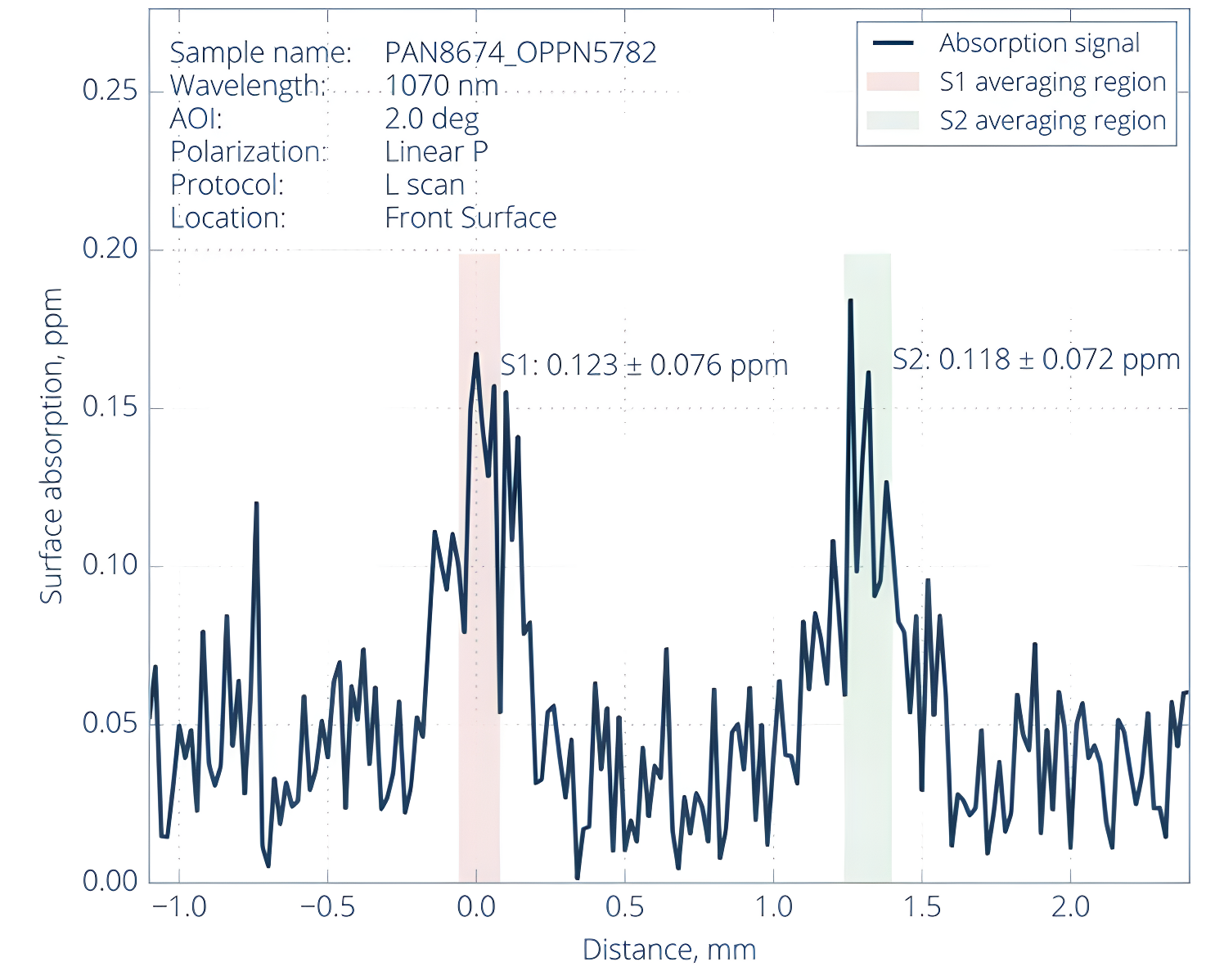 |
Figure 1. Longitudinal absorption measurement of a 1070 nm highly reflective OPTOMAN mirror.
High LIDT and Pulse Duration Considerations
The Laser Induced Damage Threshold (LIDT) is the primary metric for the survivability of an optic. While 1064 nm remains the most popular wavelength for high-power defense lasers due to the maturity of fiber laser technology, the pulse duration of the system dictates the damage mechanism. For Directed Energy Weapons, the requirements often span from ns pulse durations, used for benchmarking and certain target effects, to Continuous Wave (CW) operation for thermal destruction of targets. In the nanosecond regime, typically 10 to 20 ns, damage is predominantly thermal, driven by defect absorption within the coating.
OPTOMAN IBS coatings achieve remarkable robustness, with high reflectivity mirror LIDT values exceeding 168 J/cm² at 1064 nm, while in transmissive optics like lenses, LIDT reaches over 96 J/cm². In CW operations, the ultra-low absorption mentioned previously is the key factor in preventing melt-driven damage, allowing both Highly Reflective (HR) and Anti-Reflective (AR) coatings to withstand an extraordinary CW LIDT of 426 kW/cm at 1070 nm over a 30-second duration, a value limited only by the maximum power output of the testing laser rather than the failure of the optic. As illustrated in Figure 1, this linear threshold dictates that the maximum power handling capacity (Pmax) of the optic scales directly with the beam diameter (d), demonstrating the capability of these coatings to support scaling into multi-hundred-kilowatt directed energy systems.
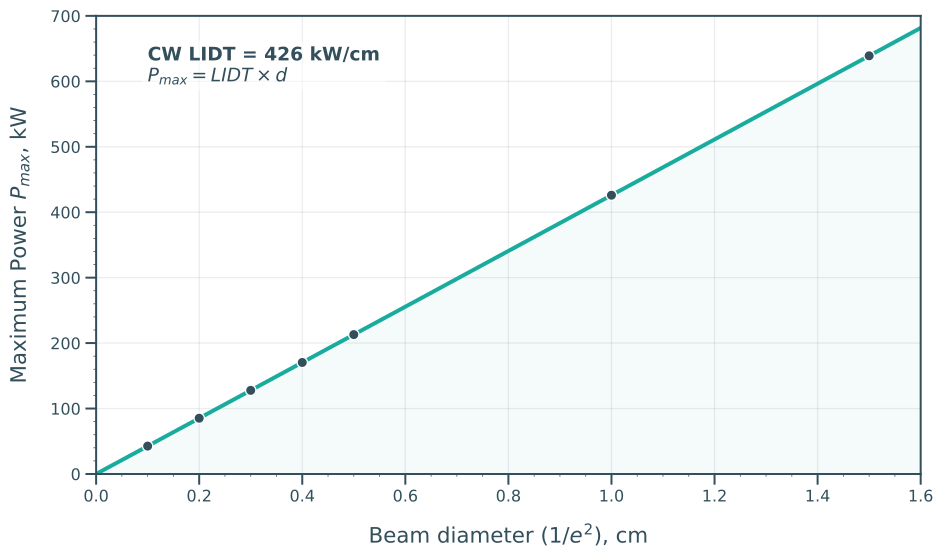 |
Figure 2. Maximum allowable continuous-wave (CW) laser power (Pmax) as a function of beam diameter (1/e²).
Environmental Stability and Thermal Cycling
As discussed earlier, DEW systems are deployed in some of the harshest environments on earth. Standard coatings are often porous and absorb moisture, which causes their spectral performance to shift as humidity levels fluctuate. Because of the bulk-like density of the layers, IBS coatings are completely immune to mechanical wear as well as changes in ambient temperature and humidity. This high density ensures smooth operation of the laser in any circumstances.
Our coatings can be used in the harshest terrestrial environments and even in outer space with no change in performance. This mechanical stability ensures that high-reflectivity zones do not shift, even when subjected to extreme temperature cycling or the corrosive marine aerosols found in naval deployments. Figure 2 illustrates a typical thermal stability test where the optic maintains performance through repeated swings from sub-zero temperatures to high heat, proving that IBS-coated laser optics achieve unmatched stability in challenging conditions.
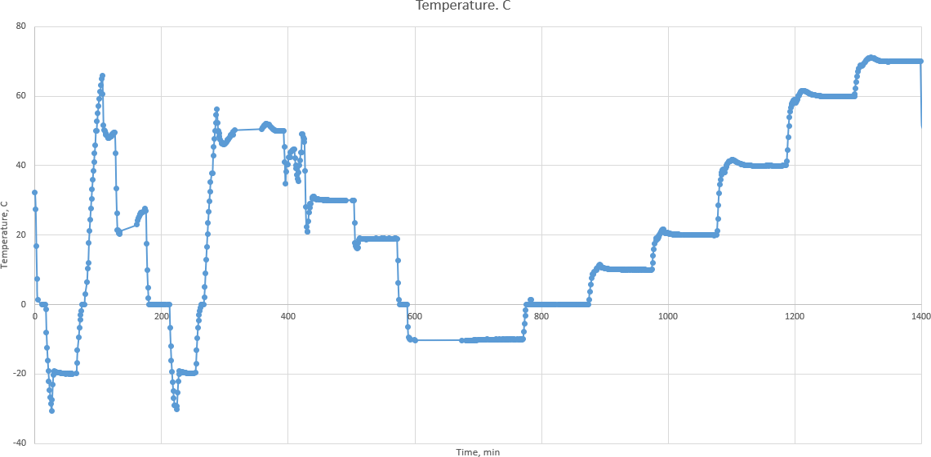 |
Figure 3. The mirror passed the test according to MIL-STD-810, and no performance change was noticed after the thermal shock.
Scaling Advanced Optics for Directed Energy to Large Apertures
The effectiveness of a DEW system is often limited by its aperture size. Larger optics allow for better beam collimation and lower divergence, which is essential for engaging targets at long ranges. Scaling high-performance IBS coatings to large diameters presents a significant engineering challenge.
OPTOMAN has mastered the manufacturing of large-format optics specifically engineered for high-power laser systems and beam expanders. By supporting substrate diameters up to 500 mm, we provide the scale necessary for advanced directed energy platforms. These optics achieve exceptional precision, with uniformity levels maintained below ±0.5% across the entire diameter. This ensures consistent spectral performance and phase control from the center of the optic to its outer edge. Additionally, the high environmental stability inherent in our IBS coatings provides the spectral reliability required for demanding high-altitude defense applications.
To illustrate how these technologies are applied in the field, we provide two design examples tailored for high-power defense applications.
Design Examples and Performance Data
Design Example #1: Low Absorption Mirrors for DELW
 |
|
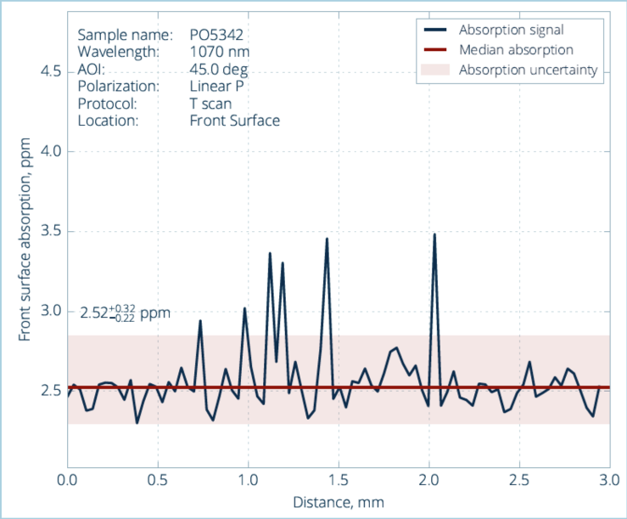
Figure 4. Transverse absorption measurement of a 1070 nm highly reflective OPTOMAN mirror.
This design is a high-reflectivity (HR) mirror optimized for the 1064 nm to 1070 nm range, featuring secondary high-reflection bands for auxiliary communication or pump wavelengths.
Design Example #2: Multi-Wavelength Alignment and Power Mirror
Modern DEW systems are complex multi-wavelength assemblies. A single mirror must often reflect the high-power 1064 nm beam (Nd:YAG or fiber laser), provide a window for 1550 nm communication signals, and offer enough reflectance at 633 nm (HeNe wavelength) to allow for visible range alignment.
- 1064 nm: High power laser beam delivery.
- 1550 nm: Communication and telemetry.
- 633 nm: Visible alignment and safety.
The reflectance plot in Figure 5 demonstrates the spectral range of this design. It maintains Ravg > 99.95% at the primary power wavelength while ensuring the system remains versatile for communication and alignment across various angles of incidence.
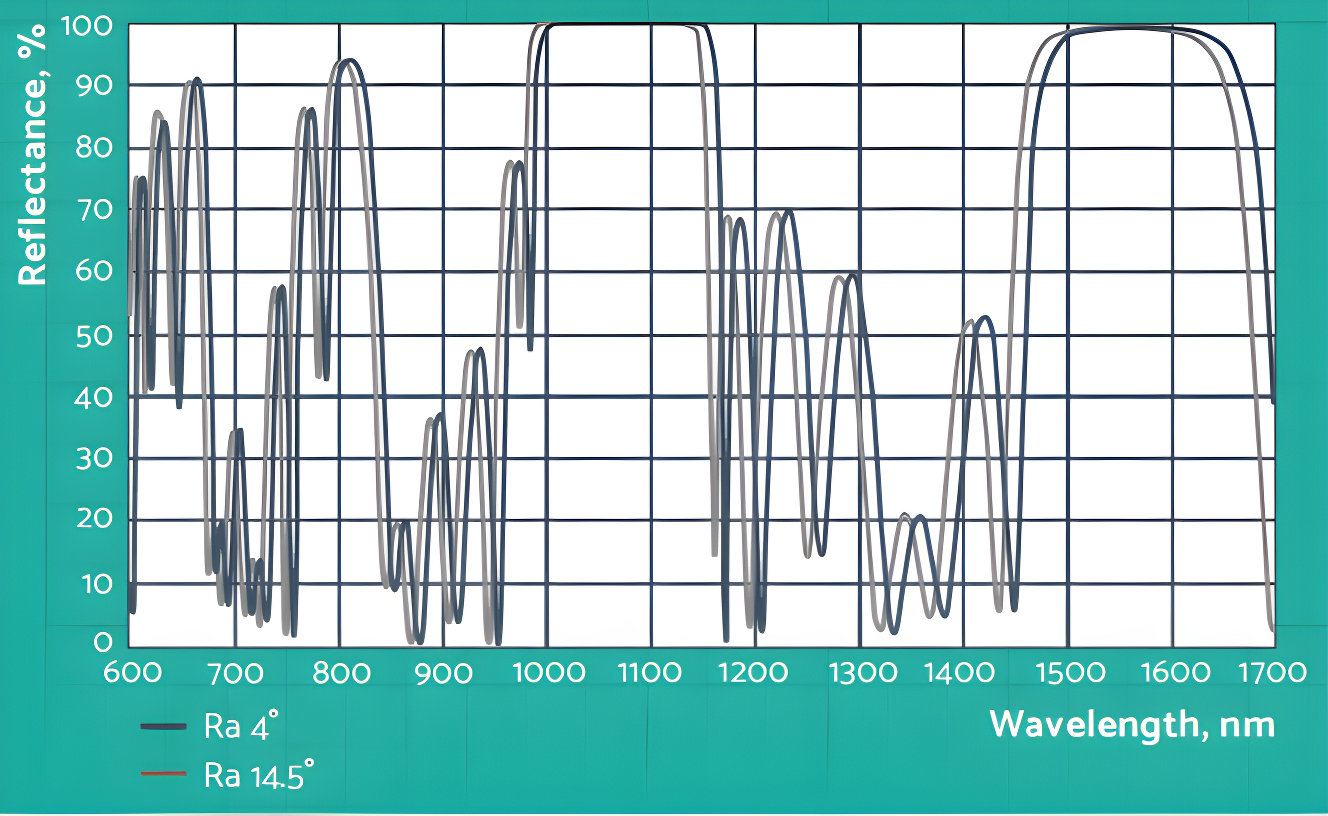 |
Figure 5. Reflectance spectra of a multi-wavelength IBS mirror demonstrating high reflectivity and spectral stability at 1064 nm and 1550 nm across various angles of incidence.
Conclusion
The transition of Directed Energy Weapons from laboratory prototypes to battle-ready assets depends fundamentally on the performance and endurance of their optical components. By leveraging advanced Ion Beam Sputtering technology, OPTOMAN provides ultra-low-loss, high-power optics engineered for maximum lifetime, enabling mission-critical laser systems to operate in extreme environments. Our high-density coatings ensure that high-power laser systems can operate reliably across land, sea, air, and space domains, maintaining beam quality and system integrity under the most demanding conditions. From ultra-low absorption levels to large-format 500 mm optics, OPTOMAN is committed to providing the critical components that define the upper operating boundary of modern directed energy systems.
Partner with OPTOMAN
OPTOMAN offers the expertise and manufacturing scale needed to push the boundaries of laser weapon performance. Our team is ready to support your mission with custom IBS solutions tailored to your specific wavelength, power, and environmental requirements.
Reach out now, to discuss your project and discover how our high-precision optics can enhance the survivability and effectiveness of your directed energy programs.