
Optical Design Efficiency in All-polarization Beamsplitters

Perfection is achieved not when there is nothing more to add, but when there is nothing left to take away. – Antoine de Saint-Exupéry.
Why Coating Efficiency Matters
In the high-precision optics industry, there is a prevailing misconception that complexity equals performance. System integrators and researchers often default to requesting “maxed-out” specifications, extreme theoretical tolerances, and massive coating thicknesses. They believe this is the only way to ensure reliability. However, this “brute force” approach creates a significant commercial bottleneck. Over-engineered coatings drive up manufacturing costs, extend lead times, and increase the risk of production failure. A coating stack that is theoretically perfect but takes weeks to deposit and is highly sensitive to the slightest manufacturing deviation is not a solution. Instead, it is a liability.
 | The real challenge for the modern optical engineer is not just hitting a spectral curve but doing so efficiently.
|
Different Approaches to Coating Design
A recent independent study by Maastricht University (Physical Review Research) serves as a case study for this efficiency-first approach. The research characterized distinct coating designs to achieve the same high-performance all-polarization beamsplitter component.
As noted in the research, the OPTOMAN design delivered reflectivity and phase shift values that were largely independent of the angle of incidence.
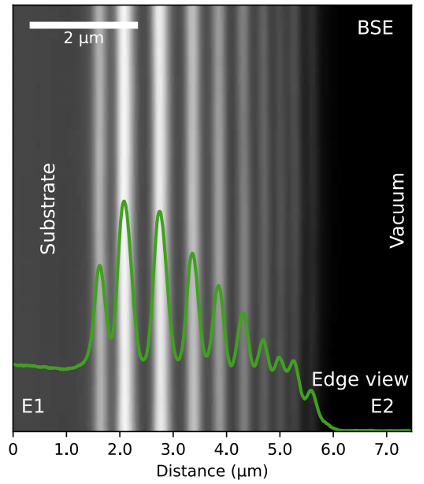
As a reference baseline, the study analyzed a conventional design consisting of a thick stack of 22 alternating layers (~5 µm thickness) (Fig. 1a). In contrast, OPTOMAN pursued a strategy focused on efficiency and material innovation. By achieving the optical function with a high refractive index contrast and leveraging Ion Beam Sputtering (IBS) technology, we realized a design consisting of only five layers with a total thickness of roughly 400 nm (Fig. 1b). This ultra-thin approach is an order of magnitude thinner than the alternative. Moreover, this efficiency not only minimizes the physical amount of coating material but also drastically lowers mechanical stress. This is a benefit we utilize in our space-grade optics to prevent wavefront distortion.
 | (a) | 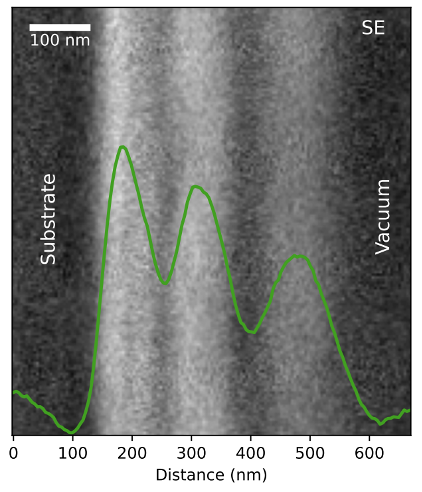 | (b) |
Figure 1. (a) BSE image of the 22-layer coating acquired in the VPSEM, looking at the polished cross section (edge view). (b) SE image of the 5-layer coating, acquired in the JEOL SEM. The green line represents the vertically integrated image intensity [1].
Difference in performance
The most significant finding of the study was the operational stability of the efficient coating design. In precision interferometry, perfect alignment is an ideal, but rarely a permanent reality. Beams diverge, mirrors drift due to thermal expansion, and setups vibrate. A coating that requires exact, theoretical alignment to function is a liability. Figure 2 summarizes the results of reflectance dependence on AOI measurement for the two samples.
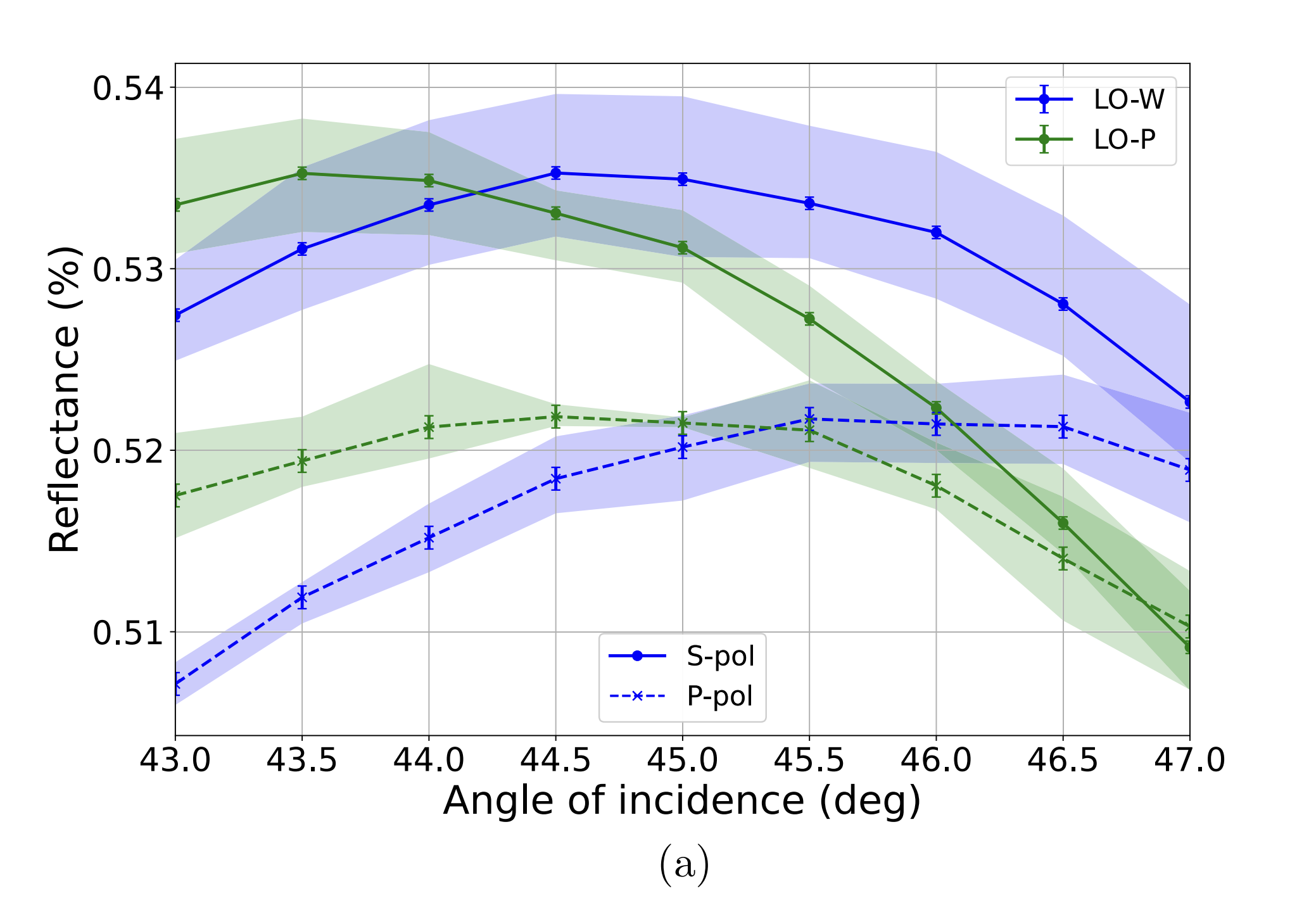 | 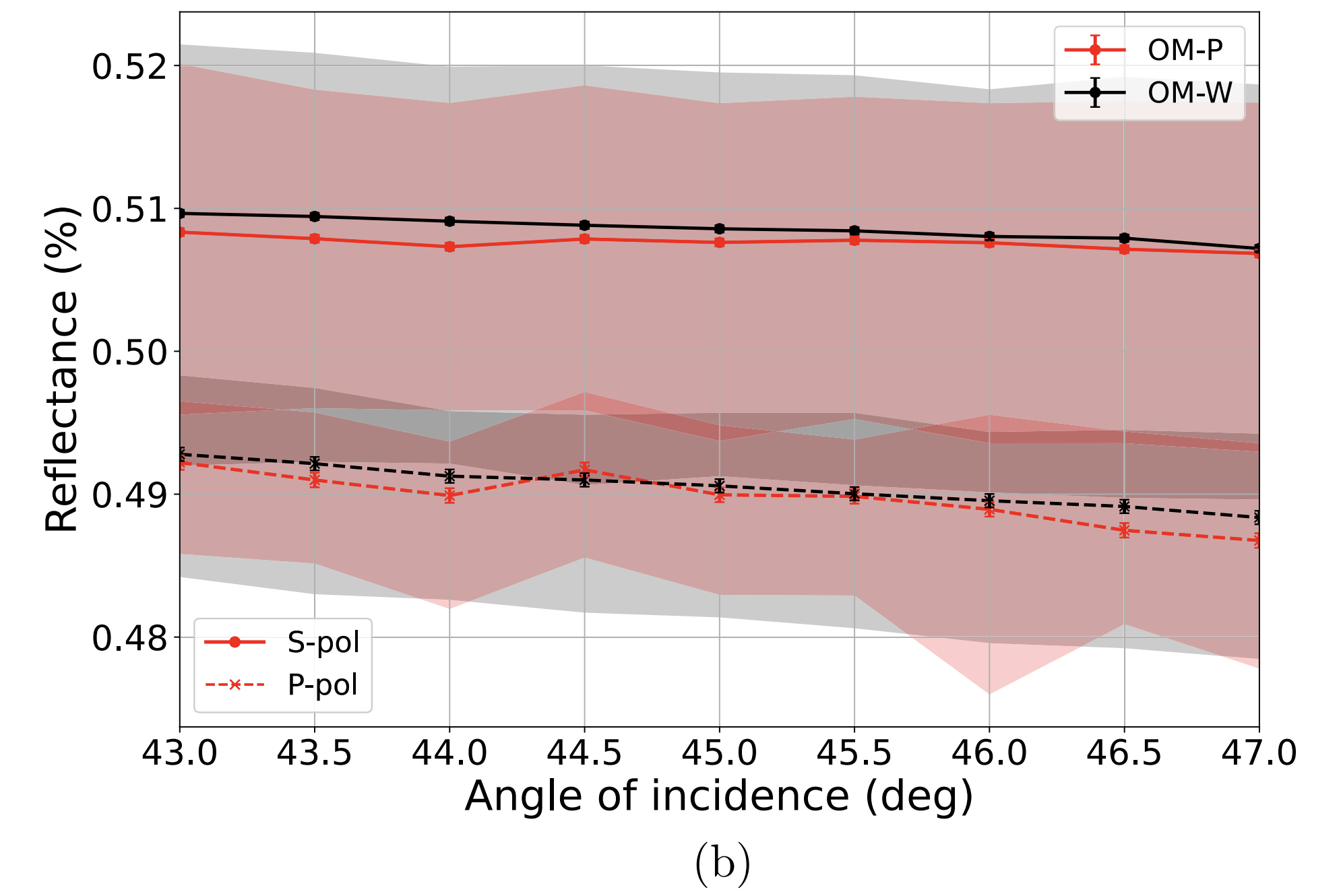 |
Figure 2. Average reflectance of the all-polarization beamsplitter coatings (a) 22-layer design and (b) 5-layer design. The additions P and W indicate whether the substrate of the beamsplitter is plane or wedged, respectively. The shaded areas are created by the highest andlowest reflectances that were measured for each category of samples, to indicate the variations for each coating [1].
The study revealed that the streamlined 5-layer design offers exceptional flatness in its performance curves. In contrast to complex multilayer stacks, which often exhibit steep performance shifts when deviating from the design angle, the OPTOMAN design delivered reflectivity and phase shift values that were, as noted in the research, “largely independent of the angle of incidence.” This stability is a direct result of the non-porous, amorphous packing density achieved via IBS. As detailed in our technical literature on 1550 nm communication optics, sputtered layers are immune to water absorption and spectral shifting. This ensures that the ‘flat’ response observed in the vacuum of the experiment remains consistent even when the optic is cycled between atmospheric and vacuum conditions.
Manufacturing Efficiency
Simplifying a coating stack from 22 to 5 layers shifts the focus from theoretical complexity to operational reliability. In laser optics, every additional layer increases the risk of thickness errors and material defects. By achieving the same optical function with fewer layers, the design inherently improves repeatability and reduces manufacturing failure rates. Physical thickness also dictates long-term durability, while traditional 5 µm stacks exert massive mechanical stress that can warp substrates and degrade the wavefront; a 400 nm design effectively eliminates these liabilities.
This ultra-thin coating design has good spectral performance for a wide temperature range, while maintaining its mechanical durability properties, making it suitable for high-sensitivity applications such as cryogenic or space-grade optics. Shorter deposition times reduce costs, enabling an “affordable premium” model. By stripping away unnecessary complexity, we deliver the extreme precision of IBS technology without the vulnerabilities of over-engineered designs. Ultimately, this efficiency helps to transform the coating process into a scalable commercial solution, meeting the needs of both cutting-edge R&D and volume production.
Summary
The independent characterization of these coatings by Maastricht University highlights a clear trade-off in optical design. While the traditional multilayer stack approach can hit specific spectral targets, they often do so at the cost of stability, resulting in optics that are sensitive to alignment and environmental changes. OPTOMAN’s ultra-thin design proves that premium performance can be achieved with a minimalistic approach.
By prioritizing efficiency and reducing the layer count, we have demonstrated a design that is both technically robust and commercially viable. For engineers where system downtime, noise reduction, and predictable lead times are paramount, this efficiency-first approach provides the most reliable path toward high-stability splitting ratios and sub-degree phase precision. In the end, perfection is not found in the complexity of the stack. Instead, it is found in the stability and simplicity of the result.
Learn more about OPTOMAN’s Non-polarizing Beam Splitters.
Browse our in-stock beam splitters in OPTOSHOP.
[1] Kranzhoff S. L., Van Ranst Z., De Bolle J., Coessens S., Danilishin S. L., Detavernier C., Smet P. F., Spencer A. P., Steinlechner J., Steinlechner S., Vardaro M., Hild S., All-polarization beamsplitters for interferometer applications, Physical Review Research, vol. 7, no. 4, p. 043068, 2025. https://doi.org/10.1103/p244-lz69