
Attosecond Laser Pulse Engineering

A new record in attosecond science
The Attoscience and Ultrafast Optics group at ICFO, the Institute of Photonic Sciences, has been a driving force in attosecond physics since 2014, when Jens Biegert’s team first generated and then isolated soft X-ray attosecond pulses in the water window [1, 2]. In 2016, Biegert’s research team at ICFO, in collaboration with Kansas State University, achieved, for the first time, the spatial and temporal resolution required to take snapshots of molecular dynamics [3]. In 2017, the group reported the first attosecond streaking measurement in the soft X-ray water window, suggesting a pulse duration of about 23 attoseconds, although methodological limitations led them to publish only a more conservative upper bound. In December 2025, the group published a new record in the Ultrafast Science journal: a 19.2-attosecond soft X-ray pulse, among the shortest ever produced [4]. It is also the first pulse shorter than the atomic unit of time, roughly 24.2 attoseconds, the natural timescale of electron motion in atoms. This enabled it to capture how matter behaves and interacts at atomic and subatomic scales with unprecedented temporal resolution.
In July 2026, at “New Frontiers in Ultrafast Quantum Optics” summer school in Lake Como, we had the opportunity to sit down with Jens Biegert to dive deeper into the possibilities, future perspectives, and limitations of attosecond science, exploring how OPTOMAN could help researchers advance in this field. Firstly, Jens explained what drew him to attosecond science.
Prof. Dr. Jens Biegert
ICREA Professor of Attoscience and Ultrafast Optics at ICFO

Jens Biegert: During my PhD, I worked in an area that combined picosecond science with OPOs, OPAs, parametric processes, and applications in molecular science and spectroscopy. This was in the United States with Jean-Claude Diels. Later, I took the opportunity at ETH, where I worked with high-harmonic spectroscopy. I found it interesting to learn something new, even though I did not really have a background in extreme ultrafast science. It was a good opportunity. I slowly tried to understand not only the technical side, but also what science could be done with it. I think it is a great field, not only because of the short pulses, but because of the control we have over radiation and what we can learn about matter.
The metrology behind attosecond pulses
Your group recently revisited an earlier attosecond measurement and obtained an even shorter pulse duration. What made that possible, and could the pulses become shorter still?
Jens Biegert: The original measurement was done more than ten years ago. At that time, the retrieval algorithms had limitations, and we were extremely careful — probably too careful. We did not claim the shortest value. Instead, we indirectly reported around 23-24 attoseconds, which is already extremely short and still a record. We preferred to describe all the complications and ensure the number was reliable. With new retrieval algorithms, we later felt confident enough to revisit the data. That is how physics should evolve: particle physics does the same thing when new models are used to reassess existing data. The revised analysis yielded a pulse duration of 19.2 attoseconds (Figure 1) [4].
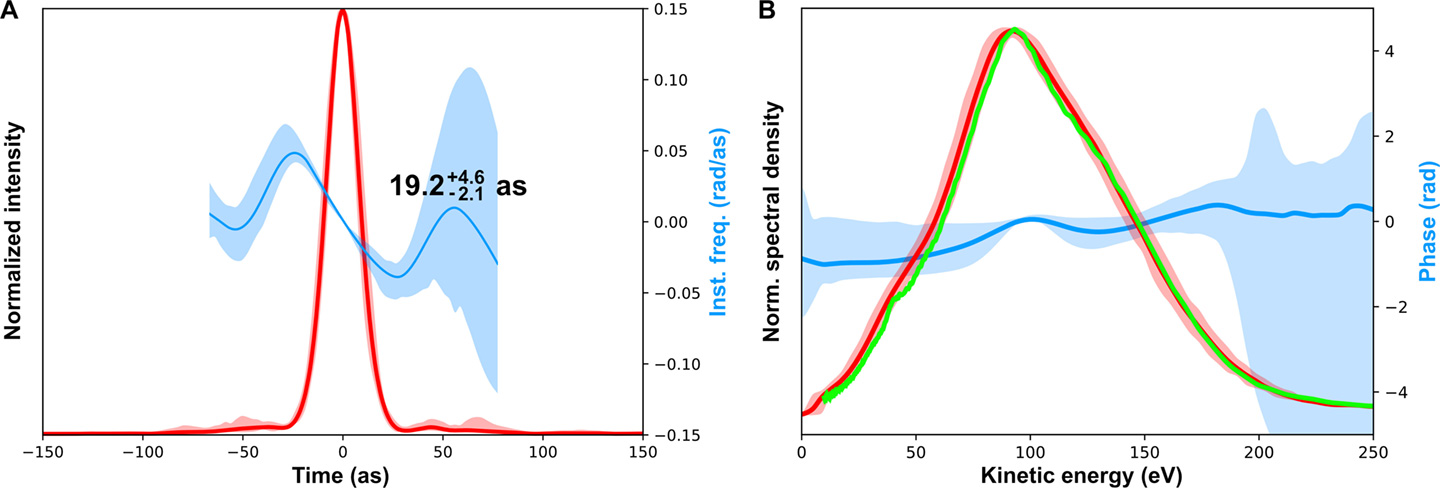
Figure 1. Measurement of the temporal form of the attosecond X-ray pulse with its associated spectrum. Credit: ICREA
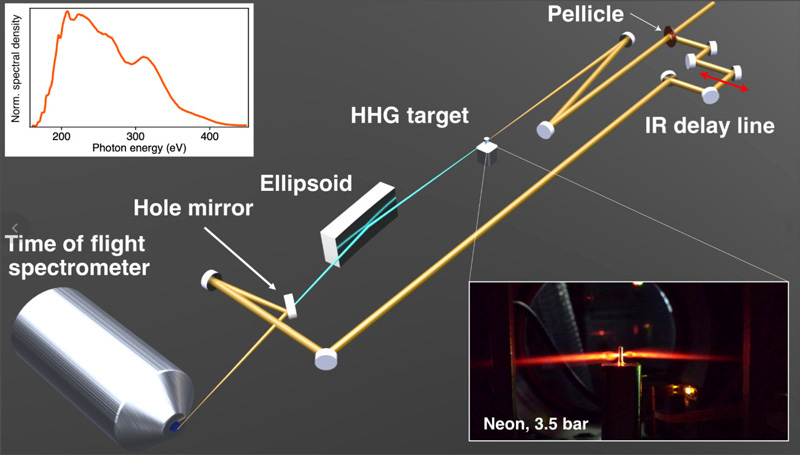
The experiment (Figure 2) used a system producing 1.8-micrometer laser pulses with a relatively limited energy of about 200 microjoules on target, yet it still generated such a short pulse. With a larger laser system and a modest shift in wavelength – perhaps from 1.8 to 2 or 2.1 micrometers – we could obtain more bandwidth, shift the central photon energy, and produce an even shorter pulse.
The other question is whether such pulses are needed for a particular piece of physics. It is wonderful to have them, but the measurement itself is a major experiment. I do not know of a group that measures the pulse duration before every experiment. It is not like quickly running a FROG or SPIDER measurement and then starting the experiment. Ten years ago, it was a heroic experiment: the setup could take half a year, and one scan lasted about eight hours. Everything had to be perfect. Nobody could be in the laboratory, measurements were done at night, everything was remotely controlled, and even opening the laboratory door could disturb the carrier-envelope phase.
The cutoff is highly dependent on the carrier-envelope phase, and that dependence becomes stronger as you move farther into the soft X-ray region. Under normal conditions, the cutoff may shift by one, two, or three electronvolts; farther into the soft X-ray, it might shift by 50 electronvolts. You have to be extremely careful. I believe the measurement can be performed much faster today, and some techniques rely solely on optical measurements, but this is still an area that needs further development.
 |
|
Figure 2. Setup and picture of the helium jet in which the attosecond pulse is generated. Credit: ICFO
The physics behind attosecond pulse generation
Attosecond pulses are generated through High-harmonic generation (HHG), an extreme non-linear process (Figure 3). It begins with the tunnel ionization of a target gas medium. The driving laser field then accelerates the freed electron, which ultimately recombines with its parent ion to emit a burst of light. While a standard laser pulse repeats this cycle to create a train of pulses, generating an isolated attosecond pulse requires restricting emission to a single half-cycle event. We explored the technical requirements behind this process.
Jens Biegert: First, to make a short pulse in this photon-energy range, you need to shift the center wavelength to short wavelengths – essentially into the XUV, or even shorter. That requires a nonlinear process, and the nonlinearity must be relatively high. To make the output reproducible, you need very stable sources, otherwise, you obtain a largely random output. The underlying requirement is therefore a highly nonlinear interaction together with very well-controlled laser parameters — more precisely, laser-field parameters.
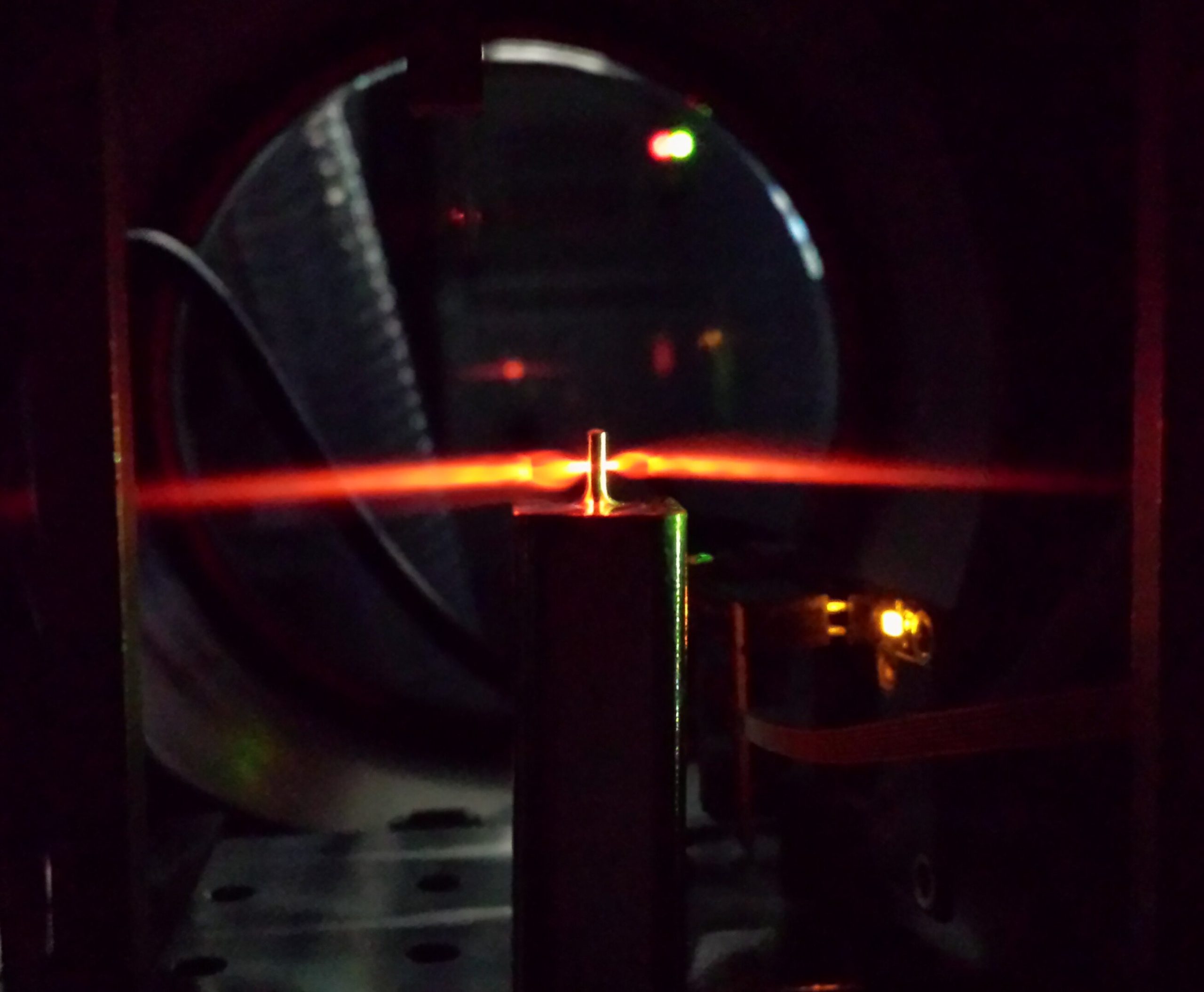
Figure 3. The image captures the generation of attosecond pulses, in which ultrashort (few-cycle) laser pulses interact with a neon gas jet. This interaction initiates high-harmonic generation, yielding the shortest attosecond soft X-ray pulse ever produced. Credit: ICFO
Producing reproducible short pulses is a different challenge because you must deal with phase matching, plasmas, and very strong plasma nonlinearities. Laser stability is again extremely important. In a nutshell, the route to short pulses is the so-called recollision process: it uses tunnel ionization of the target medium, and the dynamics are restricted to a single recollision. This can be done with very short optical pulses in several ways. My preferred approach is to go through the effort of creating those short pulses directly at the laser source. Other gating mechanisms have their own advantages and disadvantages. Once you have the short pulses, the physics becomes cleaner.
The main struggle is then to achieve high repetition rate, high peak power, and long driver wavelengths. Paradoxically, the longer the driver wavelength, the shorter the wavelength of the radiation you can generate.
Long-wavelength driver
Why are long-wavelength drivers attractive, and how do wavelength, repetition rate, peak power, and average power trade off against one another?
Jens Biegert: For me, the mid-infrared starts at about 3 micrometers, but more generally we are talking about long wavelengths. If you go too far toward longer wavelengths, the high-harmonic generation process becomes less efficient, so there is a trade-off — you cannot simply decide to work at 20 micrometers. You may generate a few photons, but perhaps not enough to experiment. We and others are developing holmium- or thulium-based systems around 2 micrometers, which I think is a very useful wavelength range. But the right starting point is the application: what do I want to do? It should not be a matter of building a laser first and only afterward deciding what it might be used for.
For molecular science, high-repetition-rate systems can be very useful because the target refreshes after every shot. In solids, however, cumulative effects become important. With a megahertz laser system, the sample may not relax back to its initial state, so the experiment may no longer measure what you think it measures. It depends on the application. There is always a trade-off among repetition rate, peak power, and average power. In gain media and even in parametric processes, peak and average power impose limitations together. People discuss half-kilowatt or kilowatt lasers, and thin-disk systems and other sources can deliver such power, but sending 300 watts through a parametric process or onto certain mirrors is another matter. At that point, the laser itself may no longer be the limiting element.
The importance of optics
How important are optical components in enabling progress, and where do they become a limitation?
Jens Biegert: Optics are essential. Advances do not come only from lasers. You can only have those lasers if you also have the optics. Even after producing the pulses, you need to deliver them to the target. Optics are sometimes underestimated, but they are extremely important. In the longer-wavelength range where I like to work, around 2 micrometers or even longer, it is difficult to make the optics. The layers can be temperamental, and the materials are sometimes not sufficiently characterized for reliable optical design.
Layer thickness control becomes a practical challenge at longer wavelengths. Dispersive mid-IR designs require thicker layers, and often many more of them, to achieve the same optical performance as fewer, thinner layers closer to the visible. A broadband design can require dozens of layers with several micrometers of total thickness, and each additional layer increases the risk that small deposition errors accumulate across the stack, along with real cost. Standard broadband optical monitoring is most reliable in the DUV range. Further into the mid-IR, OPTOMAN’s mid-IR designs instead anchor layer termination to a known reference point on the design curve, for example, at 3 µm, where the target position of the curve at that wavelength is precisely known, extending precise control up to 5 µm.
Wavefronts and spatial homogeneity
Jens Biegert: It is not only about having short pulses — you also need very good waveforms and wavefronts that can propagate and focus cleanly for phase matching. Spatial homogeneity is therefore important.
Wavefront quality is set as much by the coating as by the substrate. A film with intrinsic stress or thickness non-uniformity distorts the surface figure it is deposited on, regardless of how well the substrate was polished. IBS films are near-bulk density, and the high deposition stress can be compensated with stress-compensating coatings (SCC). Internal testing has shown that a single high-absorption defect site can reduce LIDT by more than 40% relative to a clean area of the same coating. To catch this before it reaches a customer, OPTOMAN uses ARGOS, an automated full-aperture inspection system that combines dark-field imaging with machine learning to detect and classify surface and near-surface defects down to 1 µm across the entire clear aperture, which is why full-aperture inspection is standard rather than sampling. Read more in our whitepaper, “Surface Quality Control for Maximizing LIDT in High-Power Laser Optics”.
Thermal load from absorption
Jens Biegert: The optics also have to withstand the heat load created by average power. A high repetition rate, combined with high peak power, usually means high average power as well. Chirped mirrors, or double-chirped mirrors, for example, can exhibit excessive absorption, leading to thermal effects. These components are crucial because the lasers are needed to drive the entire process and generate ultrashort-pulse XUV or soft X-ray radiation.
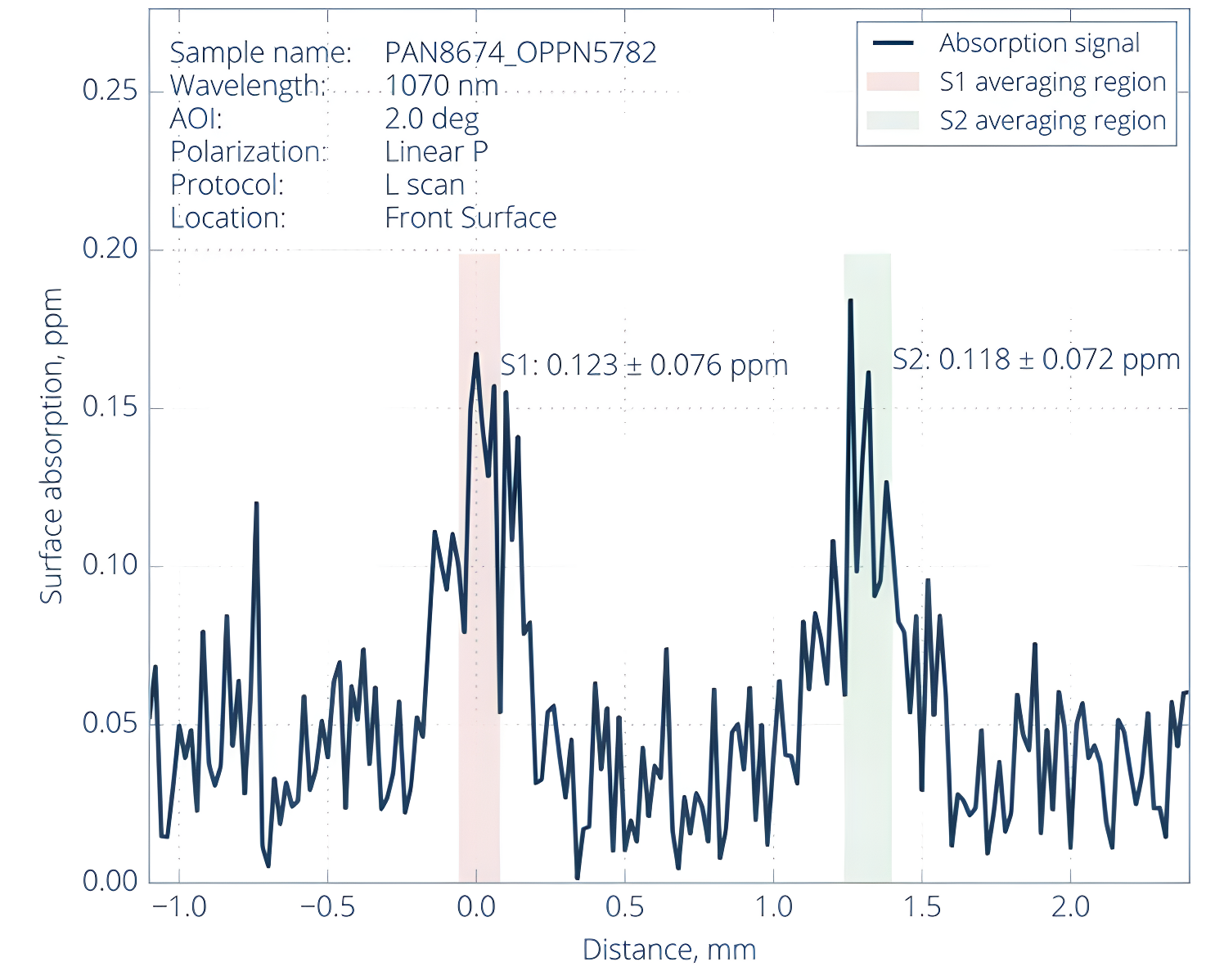
OPTOMAN’s R&D work targeting this fatigue mechanism has reduced absorption to approximately 1 ppm for s-polarization and 2 ppm for p-polarization on OPTOMAN’s high-reflectivity ultrafast mirrors (Figure 4), keeping thermal drift small enough that a mirror’s dispersion remains within its design tolerance under sustained average power.
 |
|
Figure 4. Longitudinal absorption measurement of a 1070 nm anti-reflective OPTOMAN mirror.
Phase characterization
If you could ask the optics industry to solve one problem that would help unlock the field’s potential, what would it be?
Jens Biegert: One major challenge concerns phase control and phase information. Mirrors are available for different wavelength ranges and can even be very broadband, but it is often difficult to control – or even accurately characterize – their phase response. Characterizing phase is costly for an optics company, of course. Researchers may buy a specific set of double-chirped mirrors for which information is available, while for many other components the phase response is unknown. If we knew the properties of all the components accurately, we could make systems much easier to build and operate. If the components were characterized more completely and reliable phase information were supplied, many users might not appreciate it immediately, but it would be extremely important. Your company is already doing some of this work.
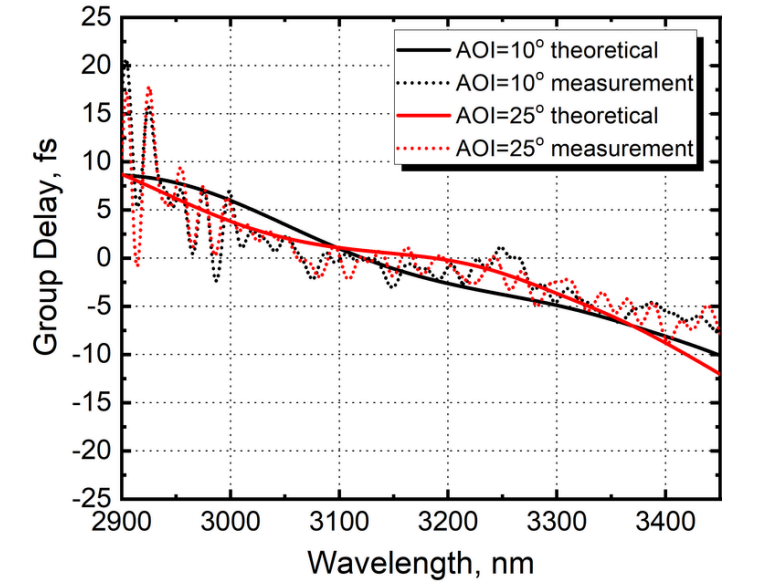
This is the gap OPTOMAN’s dispersive mirror line is built to close. Our designs are validated with Spectrally Resolved Interferometry against a Mach-Zehnder interferometer setup, with measured group delay compared against the calculated design curve at multiple angles of incidence.
The measurement shown in Figure 4 was made on OPTOMAN’s broadband mid-IR dispersive mirror, a 25-layer IBS coating with a total thickness of 7.4 µm, designed for R>98% reflectance across 2150–3700 nm with GDD running from -300 fs² at 2150 nm to +300 fs² at 3750 nm. Phase response was characterized by scanning 2860–3480 nm at both 10° and 25° angle of incidence. Across that band, the measured group delay closely tracks the calculated design curve at both angles, ranging from roughly +8 fs at 2900 nm to about -10 fs at 3450 nm. Some oscillation appears in the measured curve relative to theory, consistent with residual etalon effects in the interferometric setup rather than coating error, but the measurement stays within a few femtoseconds of the design curve across the full band.
 |
|
Figure 5. Calculated (solid) and measured (dotted) group delay curves for OPTOMAN’s mid-IR dispersive mirror at 10° and 25° AOI, characterized by Spectrally Resolved Interferometry across 2900–3450 nm.
The future of attosecond science
How has attosecond science changed, and which future applications do you find most exciting?
Jens Biegert: The field has changed tremendously. Many more people now use the techniques, even if they are not using attosecond pulses themselves. The community had to learn how to control intense, short laser pulses; how to measure them; and how they interact with gases, solids, and liquids. That knowledge has opened the field to many more researchers. You do not need a 19.2-attosecond pulse for every experiment, and that is important. It is not really a field if only ten groups can do it.
Beyond simply producing and measuring attosecond pulses, it is important to apply the techniques to problems that current methods cannot solve. I am particularly interested in attosecond soft X-ray spectroscopy. We demonstrated for the first time – and others are now doing similar work – that it can reveal how things work inside materials and molecules, including the interactions among electrons or carriers and nuclei. These degrees of freedom are often treated separately, but in the real world they are coupled.
We have not solved many of the large questions surrounding phase transitions, superconductivity, and related phenomena. I am not claiming that we are solving them right now, but these techniques offer a completely new analytical tool that those fields did not have before. That is exciting, and it is where I think the field should push next.
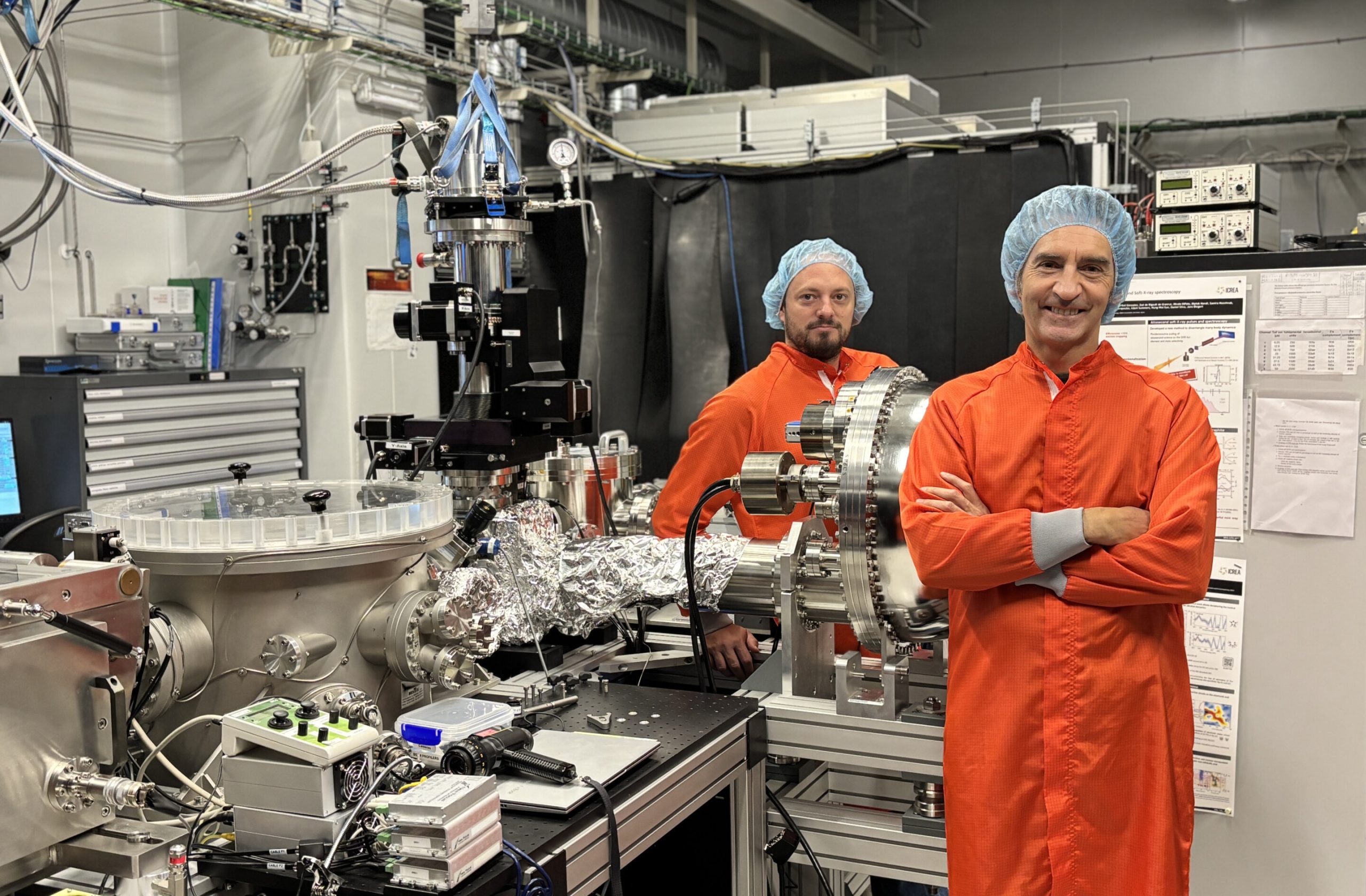
Figure 6. Prof. Jens Biegert (right) and Dr. Fernando Ardana-Lamas (left) in the Attoscience laboratory at ICFO. Credit: ICFO
Conclusion
Attosecond science has already proven the physics works. What it needs now is optics that behave predictably enough to let researchers focus on the experiment rather than the hardware: mid-IR coatings that can be manufactured reliably, mirrors that hold their dispersion under sustained average power, and phase response that is measured rather than assumed. OPTOMAN keeps working hard to ensure our IBS platform and metrology practice are built to meet these demands and push the attosecond field further.
Big thank you to Prof. Dr. Jens Biegert for his contribution to producing this article.
[1] Seth L. Cousin, Francsico Silva, Stephan M. Teichmann, Michael Hemmer, Barbara Buades, Jens Biegert, “High flux table-top soft X-ray source driven by sub-2-cycle, CEP stable, 1.85 μm 1 kHz pulses for carbon K-edge spectroscopy”, Opt. Lett. 39, 5383 (2014). https://doi.org/10.1364/OL.39.005383
[2] Francisco Silva, Stephan M. Teichmann, Seth L. Cousin, Michael Hemmer & Jens Biegert. Spatiotemporal isolation of attosecond soft X-ray pulses in the water window. Nat Commun 6, 6611 (2015). https://doi.org/10.1038/ncomms7611
[3] Michael G. Pullen, Benjamin Wolter, Anh-Thu Le, Matthias Baudisch, Michael Hemmer, Arne Senftleben, Claus Dieter Schröter, Joachim Ullrich, Robert Moshammer, Chii Dong Lin, Jens Biegert. Influence of molecular structure on ion and electron momenta in strong-field double ionization of acetylene. Science 354, 308–312 (2016). https://doi.org/10.1126/science.aah3429
[4] Fernando Ardana-Lamas, Seth L. Cousin, Juliette Lignieres, Jens Biegert. Brilliant Source of 19.2-Attosecond Soft X-ray Pulses below the Atomic Unit of Time. Ultrafast Sci. 5, 0128 (2025) https://doi.org/10.34133/ultrafastscience.0128