
Hybrid Scanning Mirrors

Laser beam steering systems continuously push the boundaries of speed, power, and precision. Applications ranging from laser material processing and LiDAR to directed energy systems, space communications, advanced sensing and imaging all depend on scanning mirrors capable of directing high-power beams accurately and repeatedly across wide fields of view. Yet the performance of the entire system is limited by the scanning mirror itself.
Why Current Solutions Are Limited
Modern systems face major challenges, including limited scan angles, reflectivity limitations, thermal distortions, mechanical wear, and increasingly demanding requirements for dynamic performance. As a result, the scanning mirror becomes a critical bottleneck in achieving higher performance, accuracy, and reliability across these applications.
Traditional dielectric mirrors provide excellent reflectivity and extremely low absorption at key wavelengths, making them well suited to high-power laser applications. However, achieving high reflectivity (R > 99.9%) over a broad angular and spectral range typically requires thick multilayer coating stacks. This added thickness makes it increasingly difficult to preserve the surface flatness that scanning applications depend on, as thin-film stress and thickness non-uniformity tend to compound with each additional layer. As scan angles increase, even small deviations in flatness translate directly into wavefront distortion and beam-pointing errors, further limiting the performance ceiling of purely dielectric designs.
Metallic mirrors on the other hand offer different advantages. They have high reflectivity over a wide wavelength and scan angle ranges. Nevertheless, higher absorption and lower reflectivity (typically R=90-99% depending on the metal) compared to dielectric coatings can lead to thermal loading, reduced efficiency and reduced power handling capabilities.
One more important challenge in beam steering systems is mechanical constraints. Increasing mirror size can support larger beam diameters and wider scan angles, but it also increases its’ inertia, as a result limiting acceleration and scanning speed. Reducing weight improves dynamic performance but can lead to mechanical instabilities, vibrations and long-term stability challenges. As a result, engineers need to compromise between scan angle, optical efficiency, thermal management and dynamic system performance (figure 1) for each application.
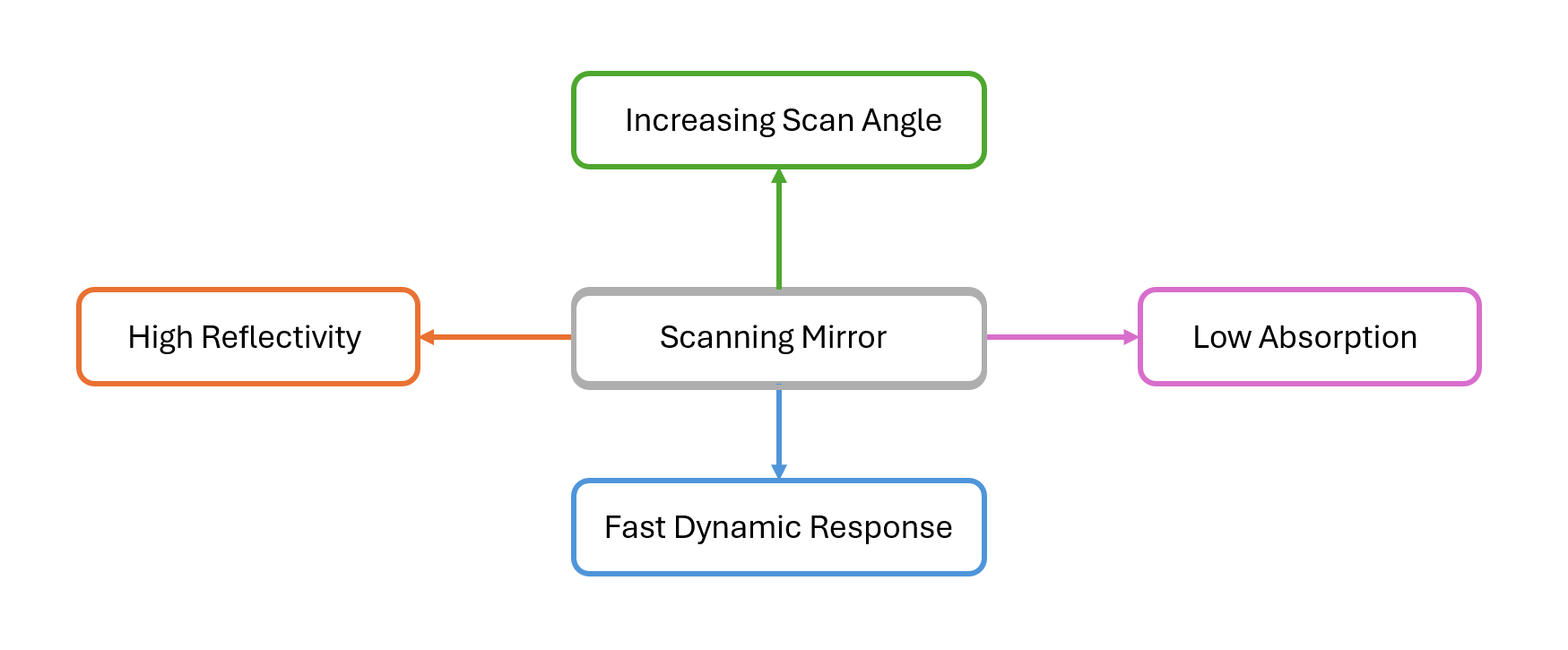 |
Figure 1. Conventional scanning mirror design requires balancing optical, thermal, angular, and dynamic performance. Improving one requirement can compromise another, creating a design bottleneck.
The Hybrid Scanning Mirror Approach
With hybrid scanning mirrors, we combine Ion Beam Sputtered (IBS) dielectric coatings with metallic coating layers in a single mirror architecture. In this architecture, the IBS dielectric layers are deposited to maximize reflectivity and minimize absorption at the key operating wavelength. The underlying metallic layer extends reflectivity across a broader spectral and angular range than the dielectric stack alone could provide (figure 2), supporting stable performance as the angle of incidence changes during scanning.
This technology can be implemented on a variety of substrate materials, including fused silica, silicon, and silicon carbide (SiC), enabling optimization for different performance, thermal, and mechanical requirements.
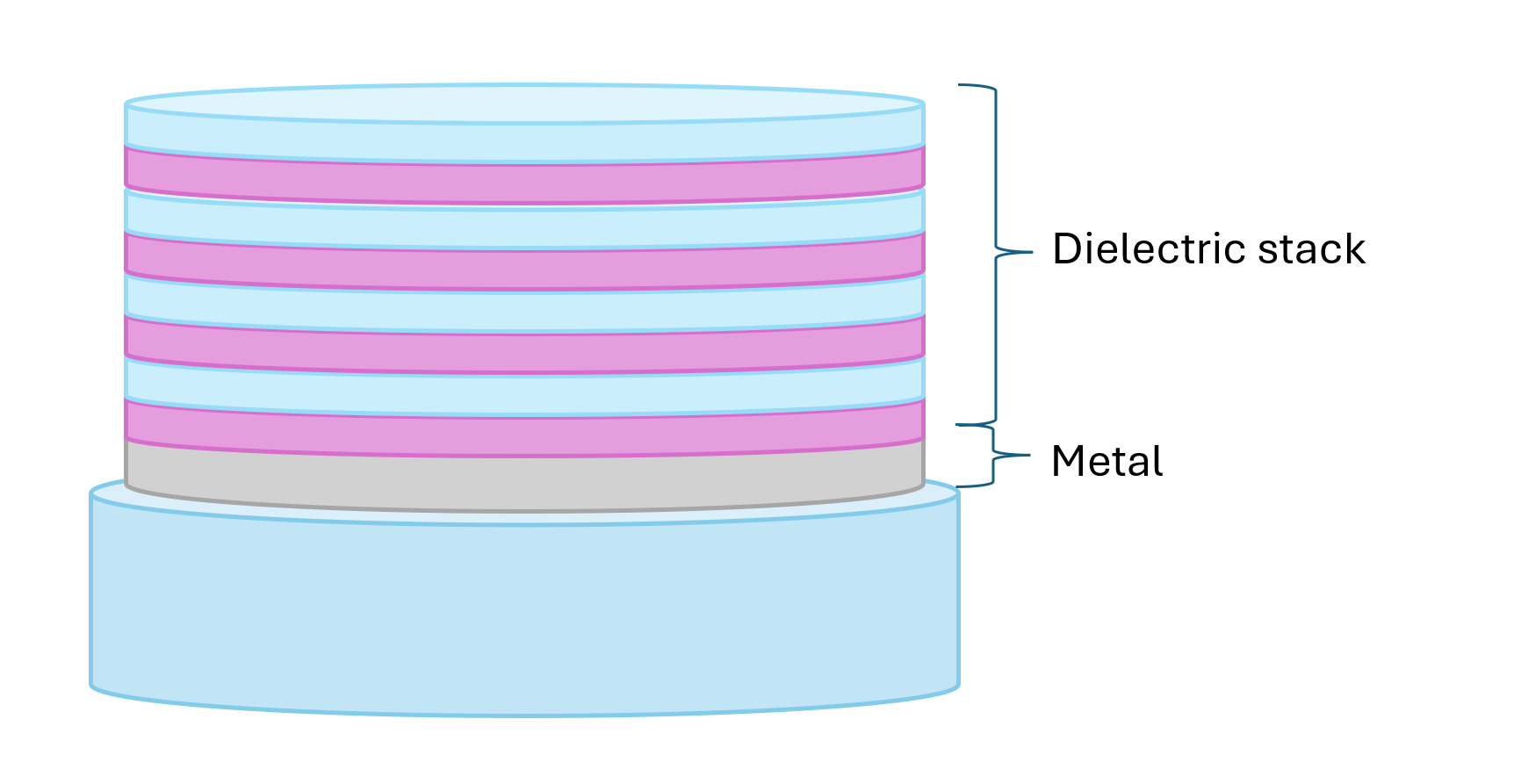 |
Figure 2. Simplified architecture of a hybrid scanning mirror combining dielectric and metallic reflectors.
This pairing was developed to address a persistent trade-off in beam steering optics: dielectric IBS coatings offer very low absorption and high damage threshold at the design wavelength, while metallic coatings offer broadband reflectivity across wide angular ranges. The result is OPTOMAN’s hybrid scanning mirrors are suited to applications where both properties are required simultaneously, including laser material processing, LiDAR, directed energy systems, space communications, and advanced sensing. By addressing several traditional scanning mirrors limitations simultaneously, hybrid scanning mirrors provide a practical route toward next generation beam steering systems. For high-power laser systems, minimal optical absorption is important. Even small levels of absorption can generate localized heating, leading to surface deformation and reduces system stability. Hybrid scanning mirrors are designed to minimize absorption while enabling broadband reflectance, stable operation under demanding thermal loads.
Optical Performance at Wide Scan Angles
Figure 3 shows the reflectance of OPTOMAN’s hybrid scanning mirror coating from 500 nm to 3000 nm, measured at 35° and 55° angle of incidence. The coating maintains ultra-high reflectivity at the target laser wavelength while providing broadband reflection from the visible to the mid-infrared, with performance sustained across both angles.
Ru(1060 nm-1080 nm) >99.9% Ru(1030 nm) > 99.85% Ru(550 nm-3000 nm) > 90%; AOI = 35-55°
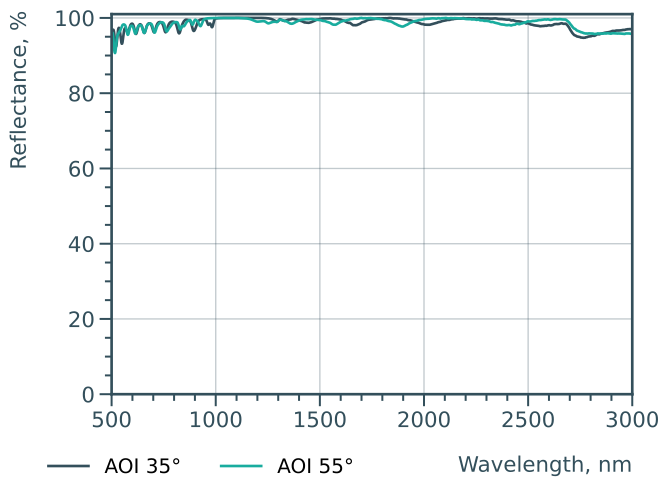 |
Figure 3. Reflectance of hybrid scanning mirror coating at 35° and 55° AOI.
At the key laser wavelengths, the hybrid coating reaches the maximum reflectivity expected of conventional dielectric mirrors, while also sustaining high reflectance across the full spectral range and the entire range of incidence angles. This angular tolerance allows larger scan angles without sacrificing optical efficiency.
Low Absorption and Thermal Stability
Absorption is another critical parameter for scanning mirrors operating under high average power. The hybrid coating approach minimizes absorption, which in turn reduces thermal effects during operation. Beyond high reflectivity and wide-angle spectral performance, resistance to laser-induced damage is a key requirement for hybrid scanning mirrors used in high-power beam steering systems. To evaluate coating robustness under demanding operating conditions, absorption and LIDT measurements were performed at 1070 nm.
Ru(1060 nm-1080 nm) > 99.9% Ru(1030 nm) > 99.85% Ru(550 nm-3000 nm) > 90%; AOI = 26-48°
a)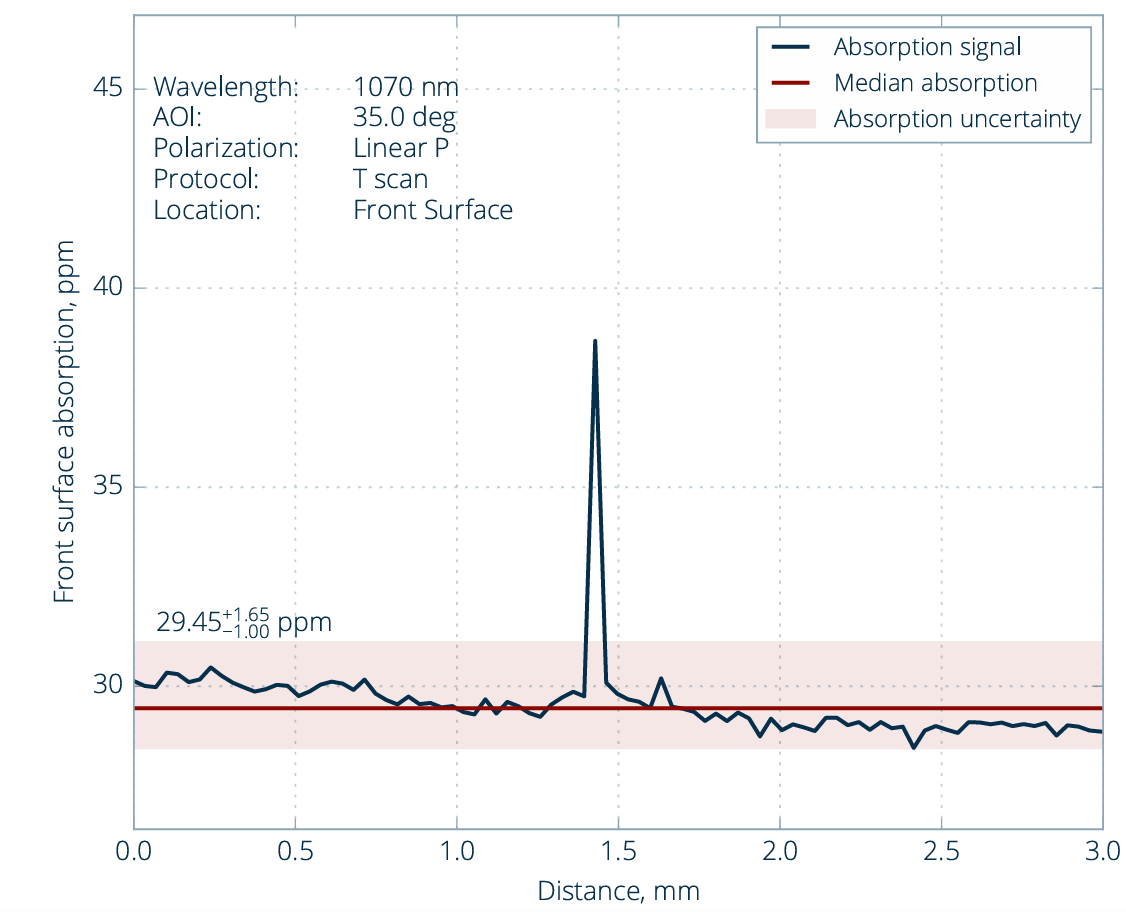 |
|
b)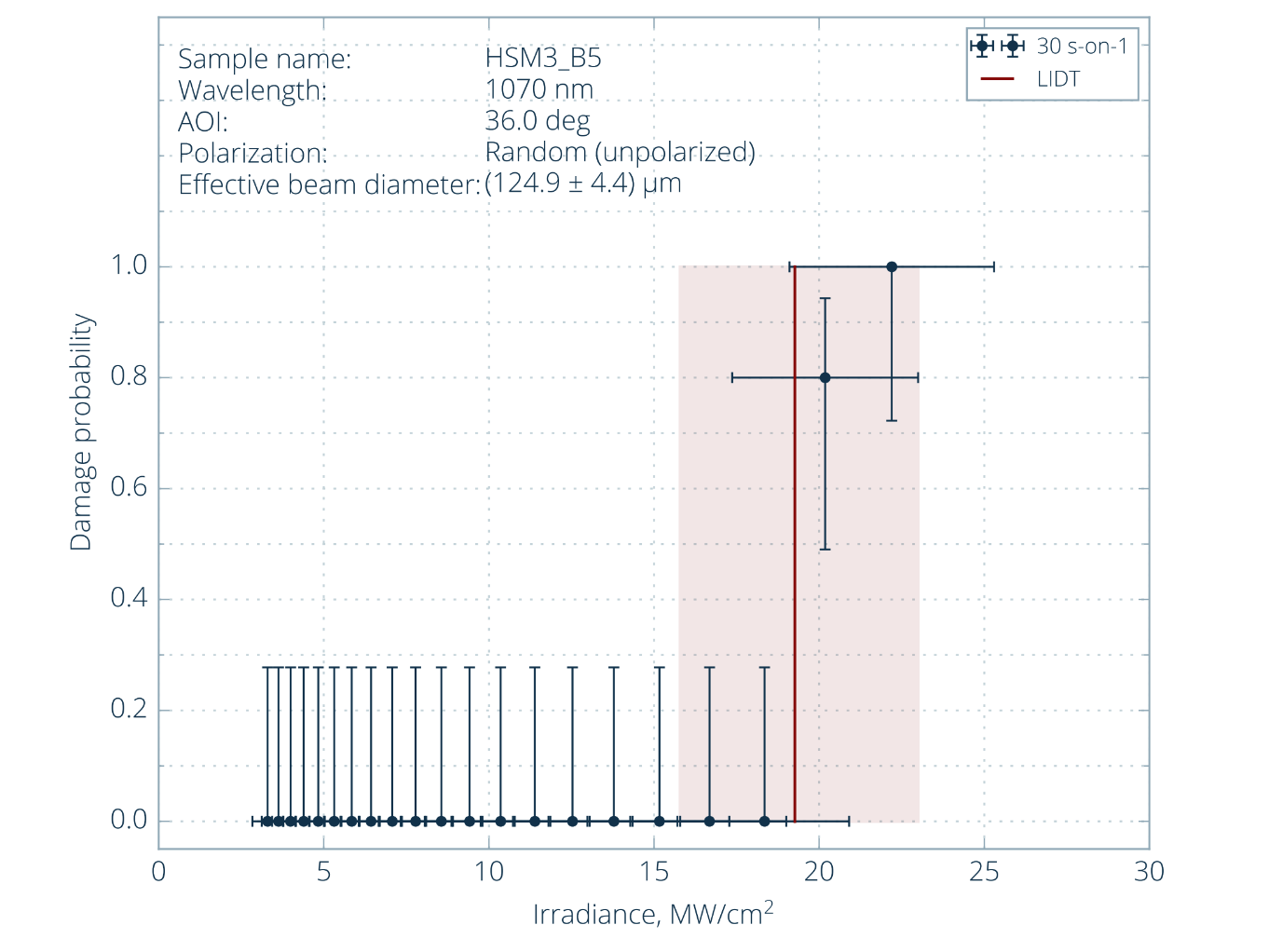 |
Figure 4. Absorption (a) and LIDT (b) measurements of the hybrid scanning mirror coating.
Front-surface absorption measurements at 35° AOI show a median value of 29.45 ppm, confirming losses below 30 ppm at the target wavelength and supporting stable operation under high-power loads. LIDT testing at 36° AOI, using random polarization and an effective beam diameter of 124.9 ± 4.4 μm, shows the coating withstanding irradiance levels up to 19.3 MW/cm² before the onset of damage. Together, these results demonstrate that the hybrid scanning mirror coating can sustain high optical loading while maintaining stable performance over time.
Comparison with Conventional Mirror Technologies
The benefits of the hybrid approach become especially apparent when compared with traditional broadband dielectric mirror designs. Figure 5 compares the theoretical reflectance of two conventional HR (high reflectivity) dielectric coating designs against the hybrid scanning mirror coating, all at 45° AOI. The standard HR design (green) reaches high reflectivity only within a limited spectral window, with sharp dips elsewhere. An enhanced BBHR (broadband high reflectivity) design (purple) extends this bandwidth but still shows ripple and reduced reflectivity at longer wavelengths. The hybrid scanning mirror coating (solid line) delivers broadband reflectance across the full 500 to 3000 nm range, with peak reflectivity exceeding 99.9% at key laser wavelengths, demonstrating its advantage for broadband, wide-angle scanning applications.
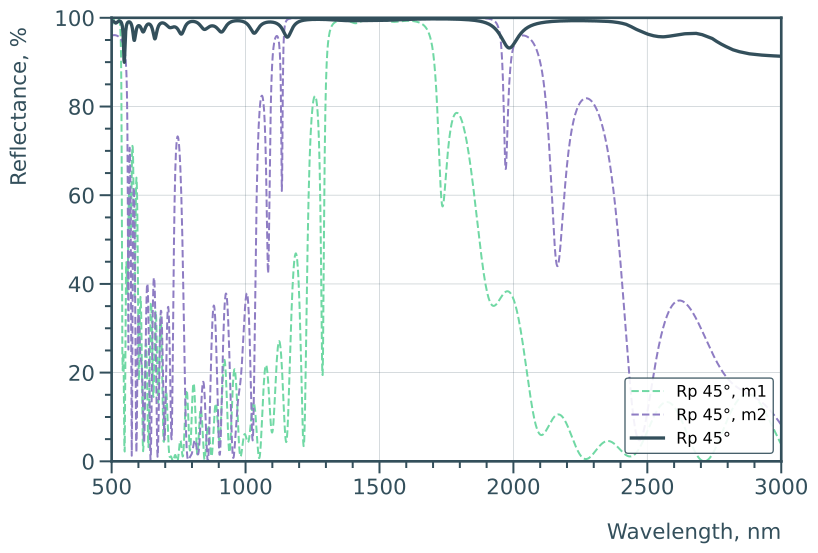 |
Figure 5. Theoretical reflectance comparison between regular BBHR (green), enhanced BBHR coating (purple) and hybrid scanning mirror coating (black).
Conclusion
By combining IBS dielectric coatings with metallic reflector layers, OPTOMAN’s hybrid scanning mirrors resolve the trade-offs that limit conventional dielectric and metallic designs. Key measured performance:
- Reflectivity above 99.9% at the target laser wavelength
- Broadband reflectance from 500 nm to 3 μm
- Absorption below 30 ppm (median 29.45 ppm at 35° AOI)
- LIDT up to 19.3 MW/cm² at 1070 nm
- Stable performance across incidence angles from 35° to 55°
Table below compares the hybrid high reflectivity mirror architecture with conventional dielectric and metallic designs. Together, these results show that the hybrid scanning mirrors deliver the optical, thermal, and angular performance required for demanding beam steering applications, including laser material processing, LiDAR, directed energy systems, space communications, and advanced sensing.
Table 1. Performance comparison of conventional scanning mirrors and OPTOMAN’s hybrid scanning mirror
| Mirror type | Advantages | Limitations |
| Dielectric | Ultra-high reflectivity exceeding 99.9% at key wavelengths, low absorption, high LIDT | Limited AOI, reduced reflectance at off-target wavelengths; thick coating stacks compromise surface flatness |
| Metallic | Broadband operation, wide AOI | High absorption, lower reflectivity (R = 90 to 99%) |
| Hybrid | Broadband reflectance across the relevant range, with peak reflectivity exceeding 99.9% at key laser wavelengths, stable across wide AOI range, low absorption, high LIDT | Requires combined dielectric and metallic coating architecture |
| Interested in testing hybrid mirrors before launch? Register your interest here.
Check out other special coatings at OPTOMAN: Membrane mirrors, Segmented coatings, Silicon carbide (SIC) mirrors |
 |