Optics for Quantum Technologies

REQUEST CUSTOM

What can OPTOMAN
do for quantum technologies?

Precision optics with sub-ppm absorption, near-zero scatter, and reflectivities exceeding 99.995%

Quantum computing and qubit readout

Computing and qubit readout

Trapped-ion, neutral-atom, and superconducting quantum processors rely on precise laser-based control and readout of quantum bits. Optical components in the beam path, including cavity mirrors, waveplates, and polarizing beamsplitters, must preserve field quality over many round trips, as even small losses degrade gate fidelity.

Quantum sensing and metrology

Sensing and metrology

Optical atomic clocks, gravimeters, and other quantum sensors achieve measurement precision beyond the classical limit by using ultra-stable lasers and cavities. Coating absorption that shifts cavity resonance, or scatter that degrades finesse, directly limits the achievable measurement precision.

Quantum communication and QKD

Communication and QKD

Quantum key distribution and quantum networking transmit information encoded in single photons or entangled photon pairs. Any absorption or scatter loss in the optical path reduces transmission distance and key generation rate, making low-loss optics essential across visible and telecom wavelengths.

OPTOMAN

FAQ

What makes OPTOMAN different from other optics manufacturers?

OPTOMAN’s mission is to be Your Hero for Laser Optics Development. We make application-optimized and highly customized solutions for you collaboratively, and do that with ultrafast turnaround, being quick to react, consult, and serve your optics needs. 


OPTOMAN is focused solely on Ion-Beam Sputtering Technology (IBS), using in-house manufacturing capabilities run by highly skilled professionals. We always aim to increase the longevity and reliability of our partners’ laser systems, eventually resulting in a lower total cost of ownership.
 

How can we be sure that OPTOMAN optics will fit our business needs?

OPTOMAN digs deep into each application, providing highly customized, application-optimized solutions that fit your business needs. 


Together, we will be able to set the priorities that are most important for your application and needs, whether it is reaching fundamental limitations, proving the concept, or making a well-balanced industrial high runner. We maintain an open discussion of the main price drivers and help customers optimize BOM costs while maintaining the highest quality standards.
 

Why Ion-Beam Sputtering Technology (IBS)?

IBS is an inherently stable sputtering process that enables OPTOMAN to produce highly repeatable laser optics with bulk-like coating density, negligible scattering, high resistance to laser irradiation, and advanced spectral performance. For quantum applications, this translates directly into sub-ppm absorption and reflectivities exceeding 99.995%, properties that are difficult to achieve with conventional coating technologies. 

We already use IBS-coated optics, so why should we consider OPTOMAN?

Laser optics manufacturing is a more complicated process than choosing the right substrates and coating materials and uploading the coating design to the IBS machine. The right intermediary between the coating design and coating chamber is essential, and that intermediary is a human with the know-how. 


OPTOMAN is driven by highly skilled professionals who aim to maximize the value of IBS-coated optics for you with an ultrafast turnaround. OPTOMAN’s market development team, together with highly skilled coating engineers, is ready to consult with you and provide highly customized, application-optimized solutions.
 

Is it possible to test the optics, and how scalable is the production?

Yes. Based on the customer’s presented business case, OPTOMAN, with its R&D-driven attitude and collaborative approach, can design, develop, and manufacture products for testing purposes and present a plan for serial production. Different-size IBS coating chambers are very handy in this case because small-scale production can be easily transferred to our giant IBS machine, Albert (the atom smasher), where we can coat large optics or 400-500 units of 1” laser optics in a single coating run, ensuring high uniformity, meaning that all optics will work the same, making your quantum systems highly repeatable and reliable too. 


Moreover, our in-stock optics marketplace, OPTOSHOP, features over 400 laser optics from OPTOMAN. These optics can be provided for testing directly from stock and delivered in 1-3 business days. After successful tests, OPTOMAN can present the optimal production plan that matches your business needs.

 

We are in the R&D phase, could OPTOMAN help at this stage?

We consider ourselves trailblazers of IBS-based optics manufacturing. We are eager to innovate in the field, so your R&D challenges are our best tasks. The passion for creating something new and our team’s satisfaction from seeing the solutions implemented are huge rewards. We have versatile manufacturing equipment suitable for prototyping and, later on, scalable mass production of thousands of units per day. 

Capabilities

Wavelength range

OPTOMAN’s IBS coating capability spans 193 nm to 5000 nm, covering DUV trapped-ion lines, visible cold-atom transitions, and telecom wavelengths for quantum networking. Coating designs are tailored to species-specific transitions, including Ytterbium, Strontium, Calcium, Rubidium, and Cesium, as well as any other atomic or ionic transition of practical interest. 

Ultra-low absorption

Surface absorption in OPTOMAN IBS oxide coatings has been measured at 0.118 ppm per surface at 1064 nm using photothermal common-path interferometry. At this level, cavity finesse scales as 1/total loss, meaning that reducing coating absorption from 5 ppm to sub-ppm levels increases cavity finesse by an order of magnitude. 

High reflectivity

Tight control over layer thickness and refractive index enables cavity mirrors with reflectivities exceeding 99.995%, supporting the finesse levels required for strong atom-photon coupling in cavity QED and optical clock applications. 

Repeatability

OPTOMAN understands the importance of repeatability, has many metrology processes, and ensures that each optic works as promised. Quantum hardware often requires multiple identical optical components within a single system, and IBS process stability ensures that spectral performance is reproduced across coating runs. 

Environmental and thermal stability

The amorphous, pore-free structure of IBS coatings is immune to humidity, temperature variation, and mechanical wear, ensuring that resonance frequencies and spectral performance remain stable over the system lifetime. 

Application optimised products

Dichroic short-pass filter
Telecom Wavelength Brewster Polarizer
Laser Mirror for 840-860 nm, AOI=0-45°
Controlled high reflectivity mirror, 950 nm, AOI=45°
Non-polarizing 1550 nm Beam Splitter
Polarizing Cube Beamsplitter
IBS Coated new-gen waveplates
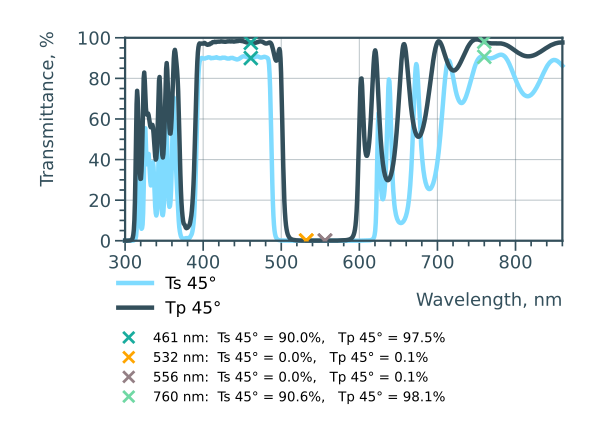
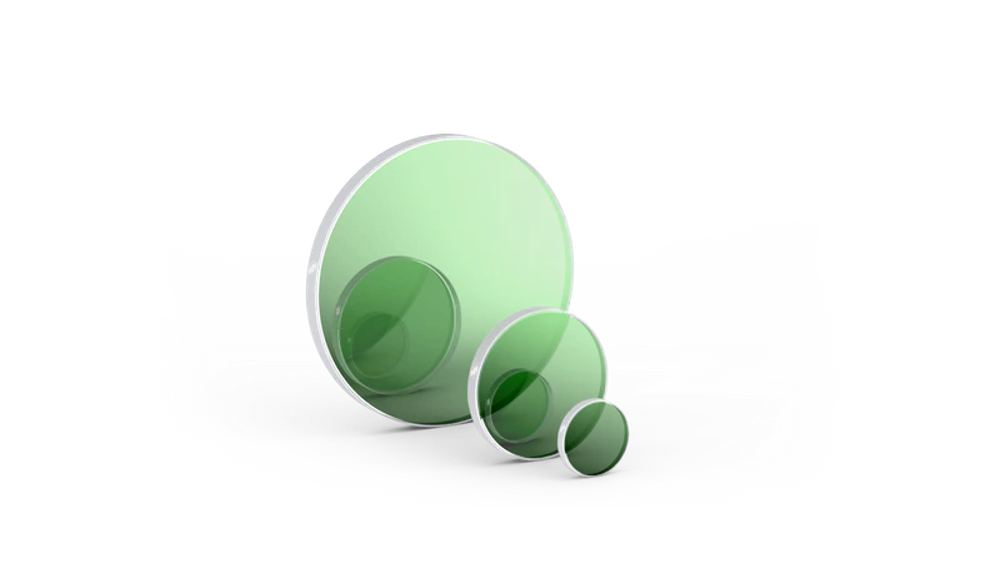
Trapped-ion and neutral-atom quantum processors require dichroic filters that separate trapping and cooling wavelengths while blocking background light at closely spaced wavelengths. This IBS-coated filter transmits at 461 nm and 760 nm for Strontium loading and Ytterbium tweezer trapping, while rejecting 532 nm and 556 nm Ytterbium cooling light, enabling precise spectral control without compromising beam quality.
  • High polarization-independent transmittance at trapping wavelengths (Ts 90%, Tp 97.5% @ 461 nm)
  • Low wavefront distortion and high LIDT enabled by IBS bulk-like coating density

Design example

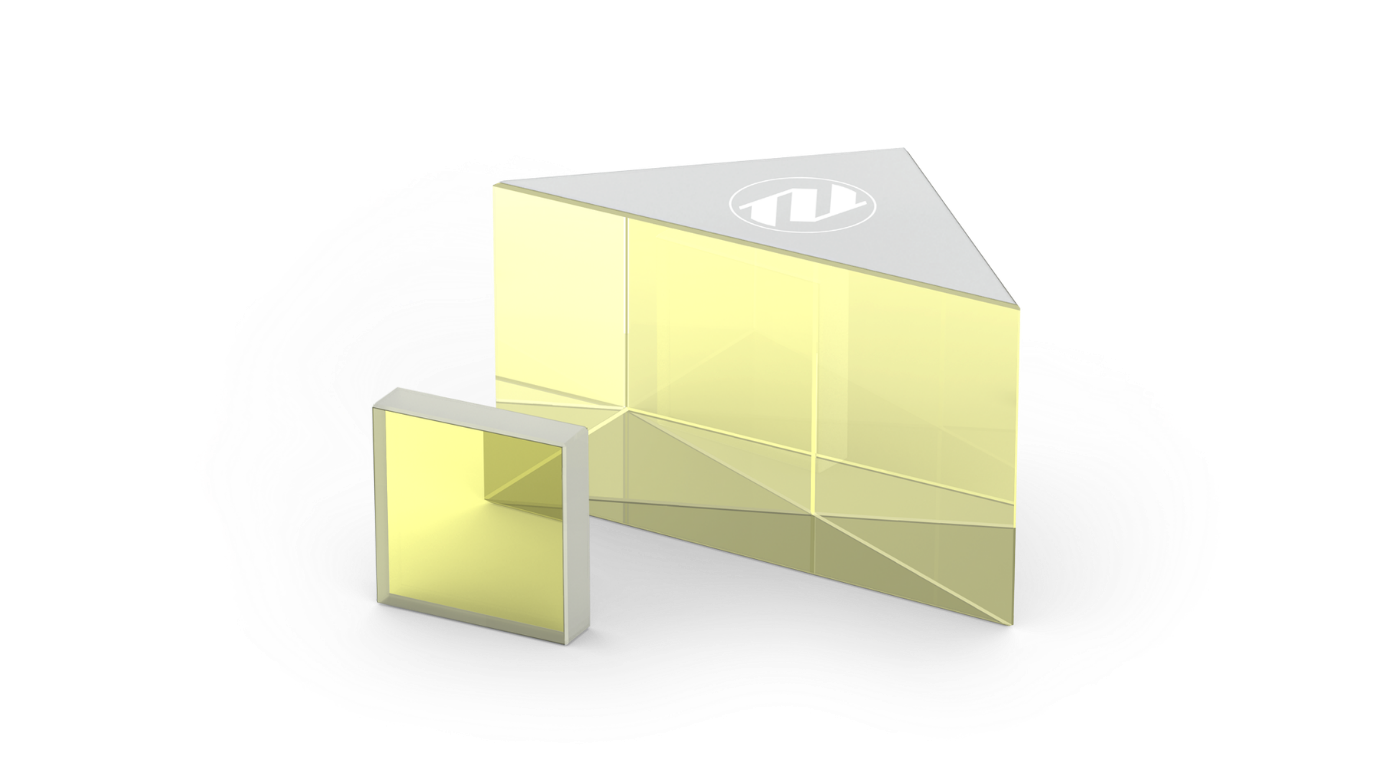
Telecom Wavelength Brewster Polarizer
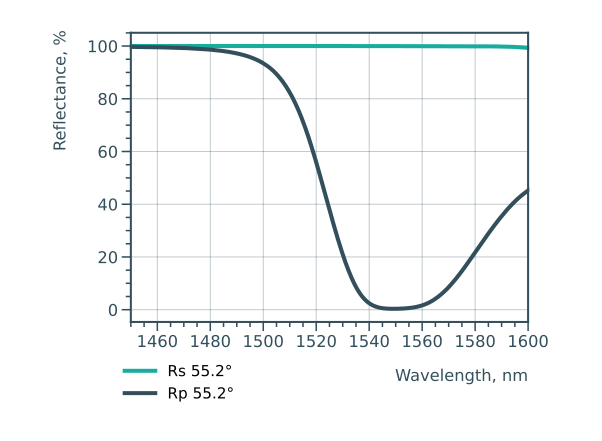
Quantum key distribution and quantum networking systems transmit polarization-encoded photons over fiber at 1550 nm, the C-band telecom wavelength chosen for its minimum fiber attenuation of ~0.2 dB/km. High-extinction polarization optics are essential at every point in the optical path, any polarization crosstalk directly increases the quantum bit error rate and reduces the achievable key generation distance.
  • High s-polarization reflectivity (HRs >99.9%) combined with high p-polarization transmission (Tp >98%) at 1550 nm
  • Low residual AR reflection (R <2.5%) on the second surface minimizing back-reflections into the quantum channel
  • IBS coating density ensures long-term stability of the extinction ratio, critical for maintaining QKD link security over system lifetime


Design example

Laser Mirror for 840-860 nm, AOI=0-45°
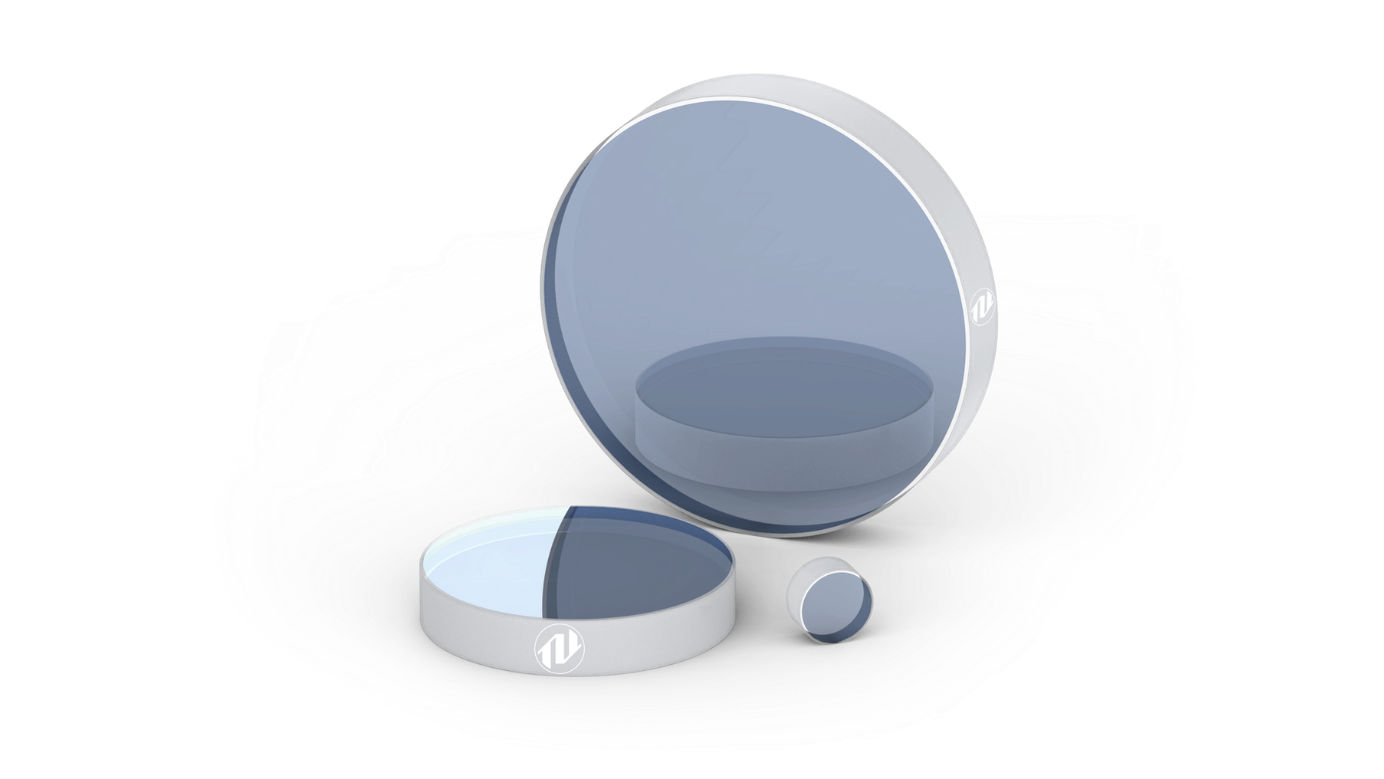
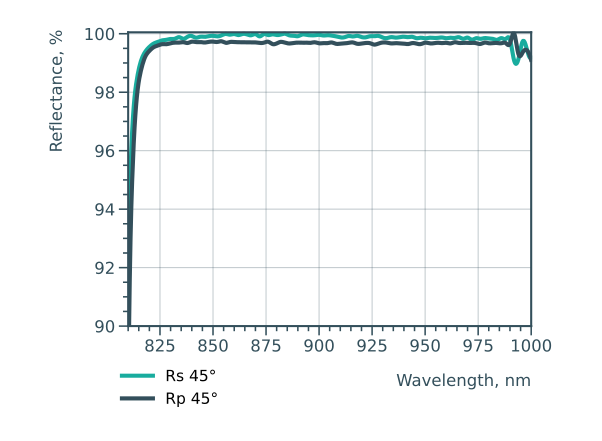
Cesium operates on its D2 line at 852 nm, one of the most widely used transitions in cold-atom physics, atomic clocks, and quantum memory systems. Beam routing in these setups often requires mirrors to perform over a broad range of angles of incidence, a demanding requirement that conventional narrowband coatings cannot meet without polarization-dependent reflectivity loss.
  • High reflectivity across both polarizations (HRp >99.9%, HRs >99.9%, HRavg >99.9%) across the full 840-860 nm band
  • Wide AOI acceptance from 0° to 45° enabling flexible beam routing in compact quantum optical setups
  • IBS coating uniformity ensures consistent performance across the aperture, critical for maintaining wavefront quality in cavity and interferometric quantum systems

Design example

Controlled high reflectivity mirror, 950 nm, AOI=45°
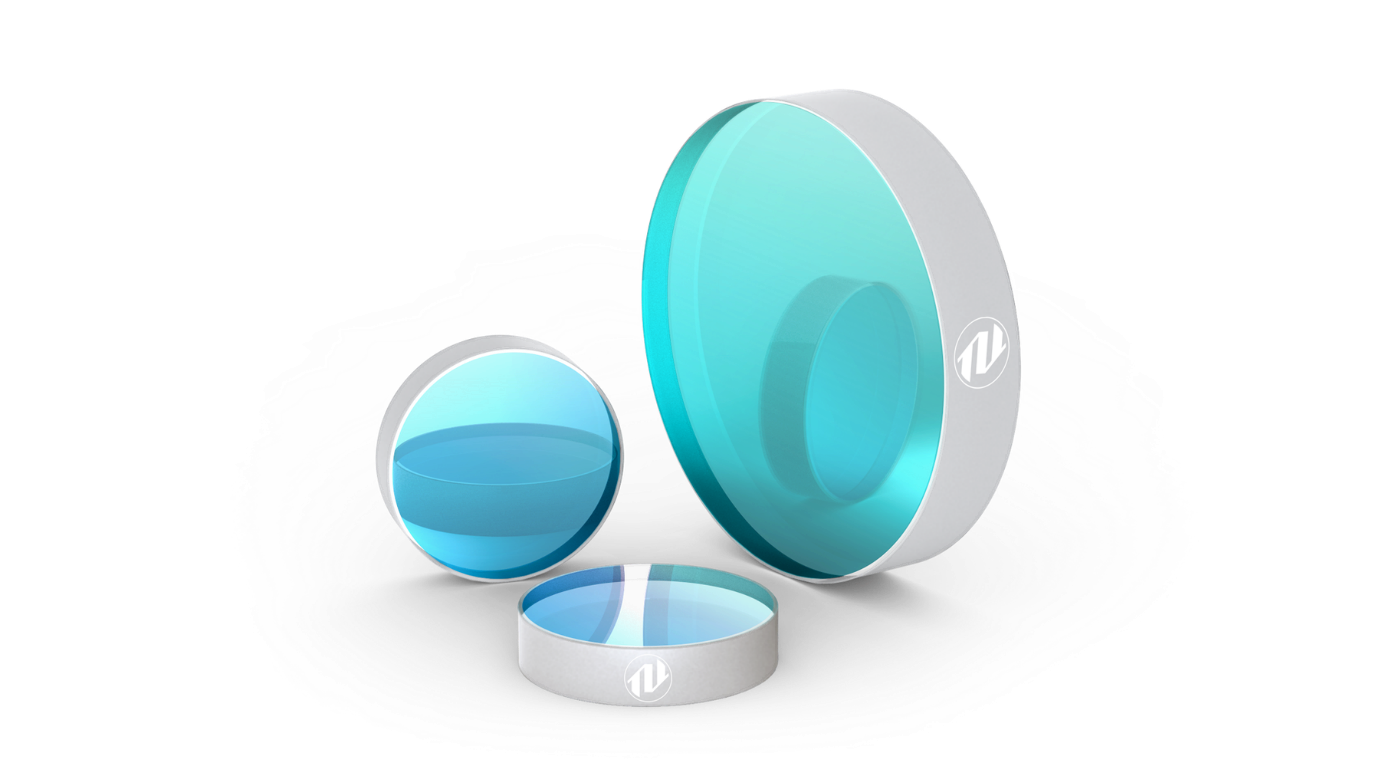
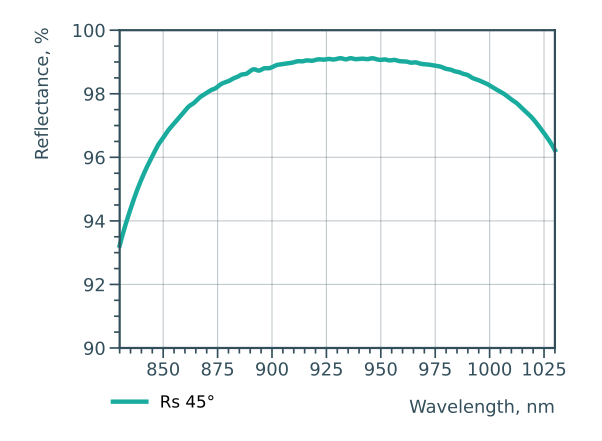
Cavity-based quantum systems, including optical parametric oscillators generating entangled photon pairs, quantum dot single-photon sources, and solid-state quantum memories in the 900-940 nm range, require output coupler mirrors with tightly controlled partial reflectivity. Even small deviations from the target reflectance shift cavity finesse and alter the coupling efficiency between the intracavity field and the output mode.
  • Precisely controlled reflectivity Rs = 99% ±0.2% @ 930 nm, enabling reproducible cavity finesse across multiple systems
  • Low residual AR reflection on the back surface (ARs <0.2%), minimizing parasitic etalon effects in sensitive cavity configurations
  • IBS process stability ensures the reflectance tolerance is maintained batch-to-batch, supporting scalable production of matched optical cavities

Design example

non-polarizing beam splitter
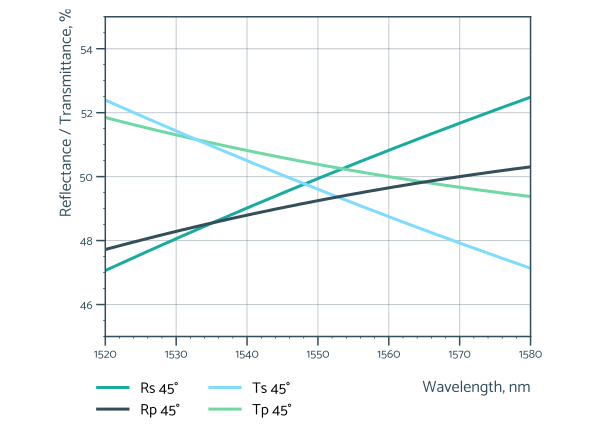
Quantum networking and QKD systems operating at 1550 nm require beamsplitters that split light with a near-perfect 50/50 ratio regardless of polarization state. When entangled photons are emitted at the same wavelength, polarization entanglement is only available if they are correctly separated at a non-deterministic 50:50 beamsplitter — any polarization-dependent splitting imbalance introduces measurement errors that directly raise the quantum bit error rate and compromise key security.
  • Polarization-independent 50/50 splitting (Rs=50% ±3%, Rp=50% ±3%) with tight polarization balance |Rs-Rp| <3% @ 1550 nm, AOI=45°
  • Low back-surface reflection (ARsp <0.7%) minimizing stray photon contributions that would increase noise in single-photon detection
  • IBS coating stability ensures the splitting ratio remains within tolerance over the system lifetime, critical for maintaining consistent measurement basis probabilities in deployed QKD links

Design example

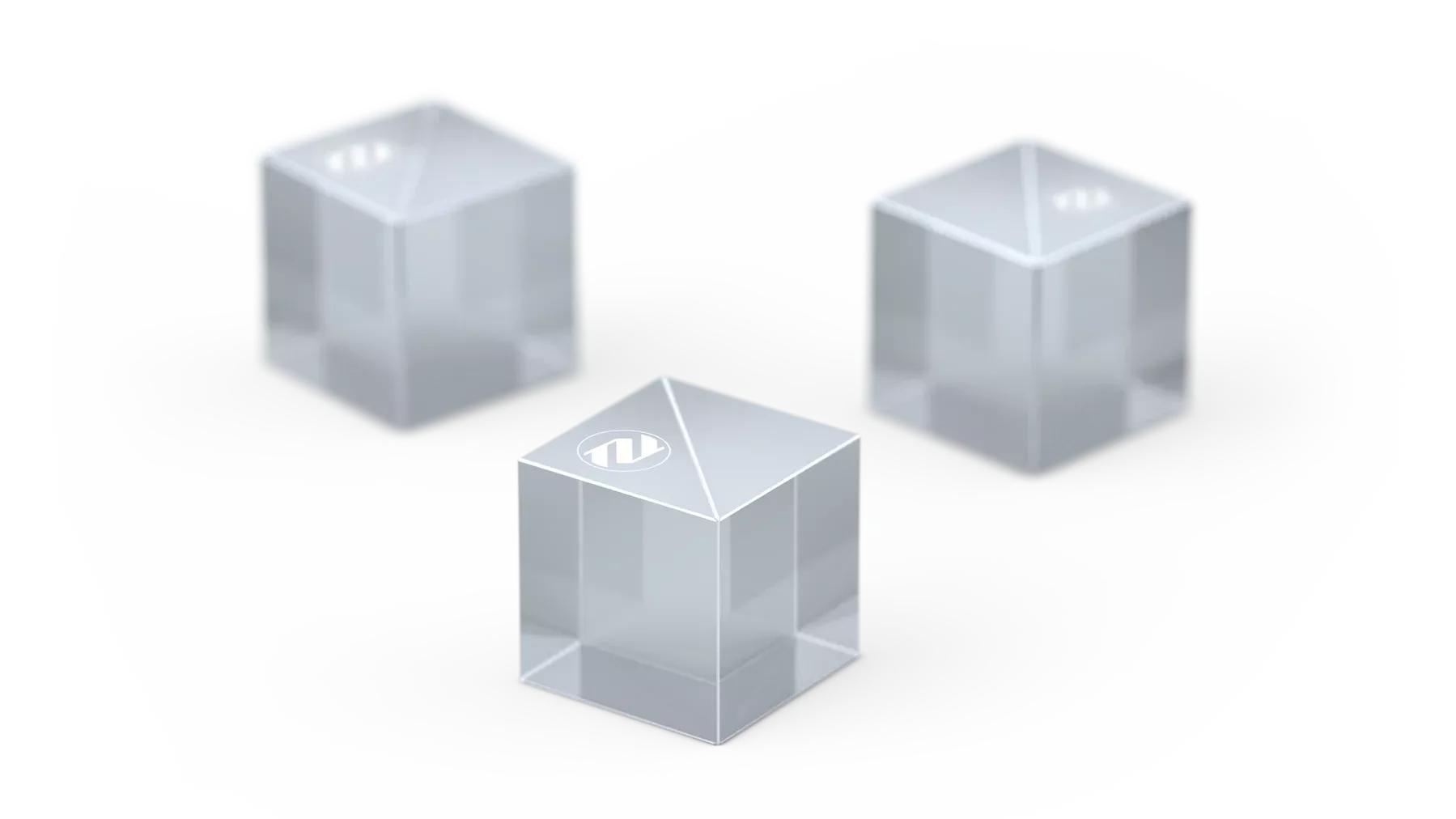
Polarizing Cube Beamsplitter
  • Material: UVFS
  • Surface quality: 20-10 S-D per CA as per MIL-PRF-13830B
  • Coatings (IBS): Rs >99.99% + Tp >97%, AOI=45°; Ra <0.1%
  • Spectral range: 343 to 1500 nm
  • Extinction ratio: >10,000:1 (>40 dB)
  • Beam deviation: <3 arcminutes
  • TWD: <λ/6 @ 632.8 nm
  • LIDT (estimated): >10 J/cm² @ 1064 nm
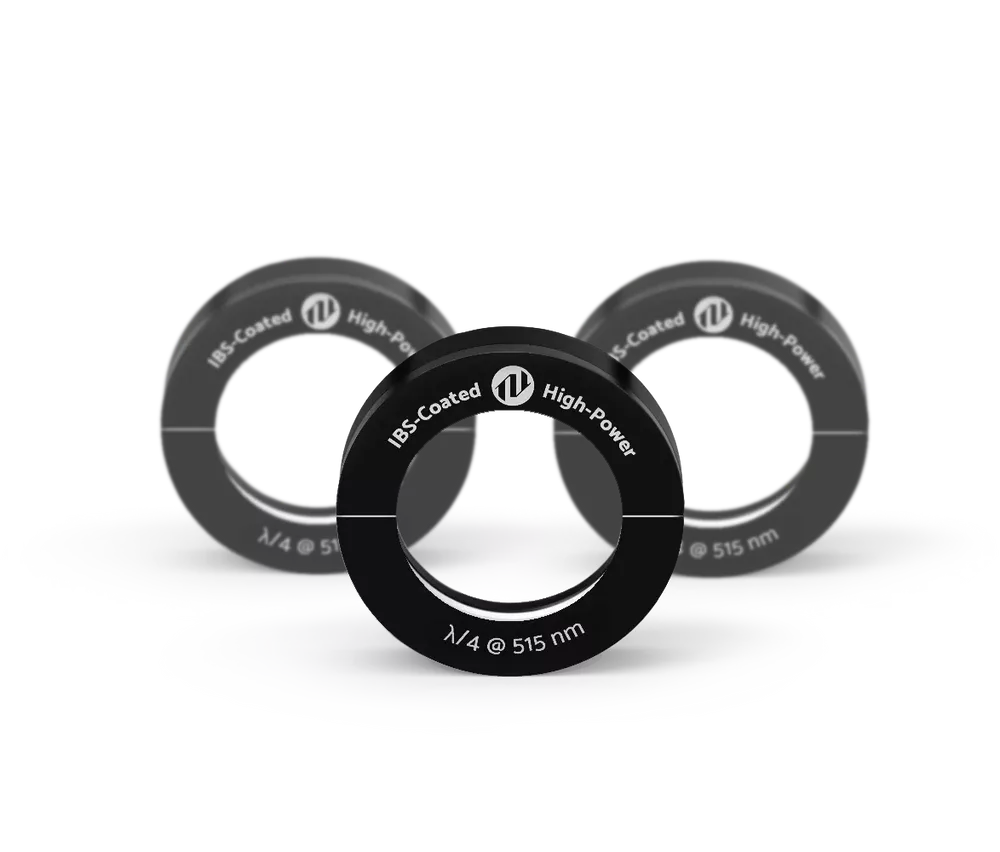
ZERO-ORDER AIR-SPACED WAVEPLATES
  • Material: Crystalline Quartz
  • Surface quality: 20-10 S-D per CA as per MIL-PRF-13830B
  • Coating (IBS): R <0.1% per surface, AOI=0°
  • Spectral range: 257 nm to 1500 nm
  • Retardation: λ/4 ; λ/2 ± λ/300
  • TWD: <λ/10 @ 633 nm
  • LIDT (measured): >0.97 J/cm², 515 nm, 200 fs, 300 kHz

Certification

Here's what
our clients say

Our high-repetition-rate laser plasma accelerator requires very high pump energies in the amplification stages of the laser. Therefore, the optics used must not exhibit any degradation over long periods, including billions of shots. Thanks to Optoman, this problem has been totally overcome. After months and even years of use, there is no sign of coating degradation, which is a sign of their good work.

Dr. Juan B. Gonzalez-Diaz, Laser Engineer at DESY

OPTOMAN’s 0-45° mirrors ULLM19 and dual-wavelength ultrafast mirrors (1030+515 nm) have been extremely useful to our work. Both products deliver exceptional performance and quality!

Anne-Lise Viotti, Assistant Professor at Lund University

OPTOMAN's expertise and reactivity have made them our trusted partner for developing dispersion-controlled optics at unique wavelengths.

Clement Ferchaud, Extreme Light Consortium, Imperial College London, UK

The OPTOMAN optics perform excellently in facilitating high-power, high-energy, and ultrafast Yb lasers, which provides a strong foundation for its application in high flux EUV generation and attosecond spectroscopy.

Xiaochun Gong, College of Optical Science and Engineering, Zhejiang University, China

Laser engineers appreciate OPTOMAN's transparency and reliability the most.

Many new scientific segment customers come to OPTOMAN because of peers' recommendations, as 9/10 customers would recommend OPTOMAN to colleagues.

Fill out a custom request

Relax and build your laser. OPTOMAN has your back.

    Dimensions
    Incorect value
    Incorect value
    Coating type
    Incorect value
    Incorect value
    Incorect value

    Laser parameters (for LIDT optimization)

    Incorect value

    Incorect value

    Incorect value

    Incorect value

    Incorect value

    Incorect value

    Incorect value
    Incorect value
    Incorect value
    Incorect value
    Incorect value
    Incorect value
    0/2500
    Incorect value

    I agree to the Terms of Use and Privacy Policy 

    Thank you
    for your request

    We will contact you as soon as possible

    CONTACT OPTOMAN

    Gabrielius Rimšelis

    Gabrielius Rimšelis

    Head of Sales

    Meet us at the main
    industry events

    Filter by:
    Laser Manufacturers
    Laser Processing
    Medical
    Scientific
    Space and Defence

    Resources

    Laser Optics for Quantum Applications

    LIDT Capabilities

    Metrology

    Ion beam sputtering technology

    Ion Beam Sputtering (IBS)Coating Technology

    DEFINING HIGH POWER IN LASER OPTICS

    Defining High Power in Laser Optics

    Ion Beam Sputtering (IBS) coated laser optics

    Ion Beam Sputtering (IBS) coated laser optics