
Laser Optics for Quantum Applications

Quantum photonics encompasses a broad set of technologies, including quantum computing, quantum key distribution (QKD), quantum sensing, and precision metrology. They rely on lasers to interact with matter at the quantum level. The roles these lasers play are varied: pumping single-photon emitters, manipulating and reading out quantum bits, trapping and cooling atoms or ions, and performing precision spectroscopy in sensing and metrology systems. In each case, the laser must meet demanding requirements: a precisely defined emission wavelength, narrow linewidth, low intensity and phase noise, and long-term frequency stability.
What these applications share is an intolerance of optical loss. A cavity mirror with excess absorption shifts resonance frequencies under laser illumination, destabilizing atomic or ionic transitions. A scatter event degrades photon coherence. A drift in spectral phase costs gate fidelity in a quantum processor or a key in a QKD link. Unlike classical photonic systems, quantum systems are far less tolerant of loss and noise. The optical coatings can therefore be a critical determinant in cavity-based and low-loss architecture.
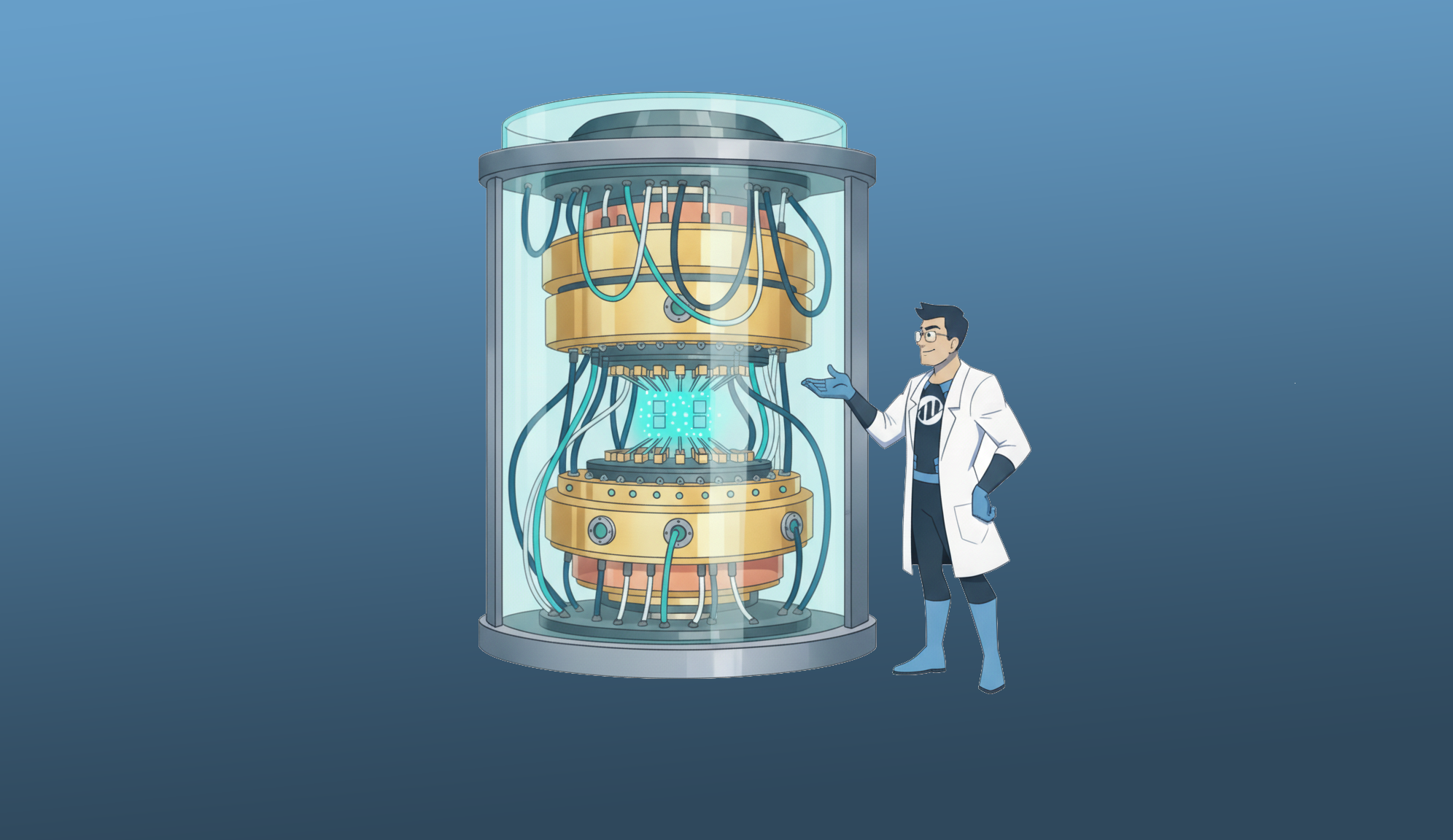
Lasers in quantum photonics
Quantum photonics calls on lasers in four distinct roles, each placing specific demands on the optical components in the beam path.
Single-photon and photon-pair generation
Single-photon emitters, as used in quantum communications, require a pulsed pump laser, typically at the picosecond level for quantum dot sources, with low pulse energy, high beam quality, and an emission wavelength matched to the emitter. Entangled photon-pair generation via spontaneous parametric down-conversion in nonlinear crystals demands a pump with a short emission wavelength, narrow linewidth, and high spatial coherence. In both cases, any absorption or scattering in the beam path reduces source brightness and degrades the purity of the quantum state.
Quantum bit manipulation and readout
Quantum bits, or qubits, are initialized, controlled, and read out using laser pulses tuned to specific transitions. The laser must emit at the correct wavelength, have a linewidth narrow enough to address the transition selectively, and be precisely controlled in pulse timing and energy. Cavity optics surrounding the qubit must preserve field quality over many round trips, making low absorption and high reflectivity essential.
Atom and ion trapping and cooling
Magneto-optical traps, optical lattices, and ion traps require continuous-wave lasers at species-specific transition wavelengths, which are often not accessible with common laser gain media. Sustained, spectrally pure illumination must be maintained over extended experimental runs. Any change in cavity resonance frequency due to thermally induced coating absorption directly undermines the stability of the trap. Species of interest include Ytterbium (399 nm, 1064 nm), Strontium (461 nm, 698 nm), Calcium (397 nm, 866 nm), Rubidium (780 nm), and Cesium (852 nm), among others.
Precision spectroscopy, sensing, and metrology
Ultra-stable, narrow-linewidth lasers with low phase and intensity noise are used in quantum sensing devices where entangled photons, single photons, or squeezed states of light enable measurements beyond the classical limit. In some configurations, a frequency comb from an accurately stabilized mode-locked laser replaces single-frequency output. Even small wavelength drift or spectral broadening degrades signal contrast, increases off-resonant excitation, and reduces the effective interaction strength with narrow atomic transitions. The mirrors and beam-steering optics in these systems must contribute to negligible phase disturbance.
The OPTOMAN solution
OPTOMAN addresses these requirements through Ion Beam Sputtering (IBS) technology, which produces dense, amorphous coating layers with absorption below 1 ppm per surface, near-zero scatter, and batch-to-batch repeatability. For cavity-based quantum systems, reflectivities exceeding 99.995% are achievable. Coating designs are tailored to the specific transition wavelengths of atomic and ionic quantum platforms: from DUV trapped-ion lines (Ytterbium at 399 nm and 1064 nm, Strontium at 461 nm and 698 nm, Calcium at 397 nm and 866 nm) through visible cold-atom transitions (Rubidium at 780 nm, Cesium at 852 nm) to telecom wavelengths for quantum networking. The full capability spans 193 nm to 5000 nm, covering single-wavelength HR designs, multi-wavelength HR/HT combinations, and polarization-selective coatings for any atomic transition of practical interest.
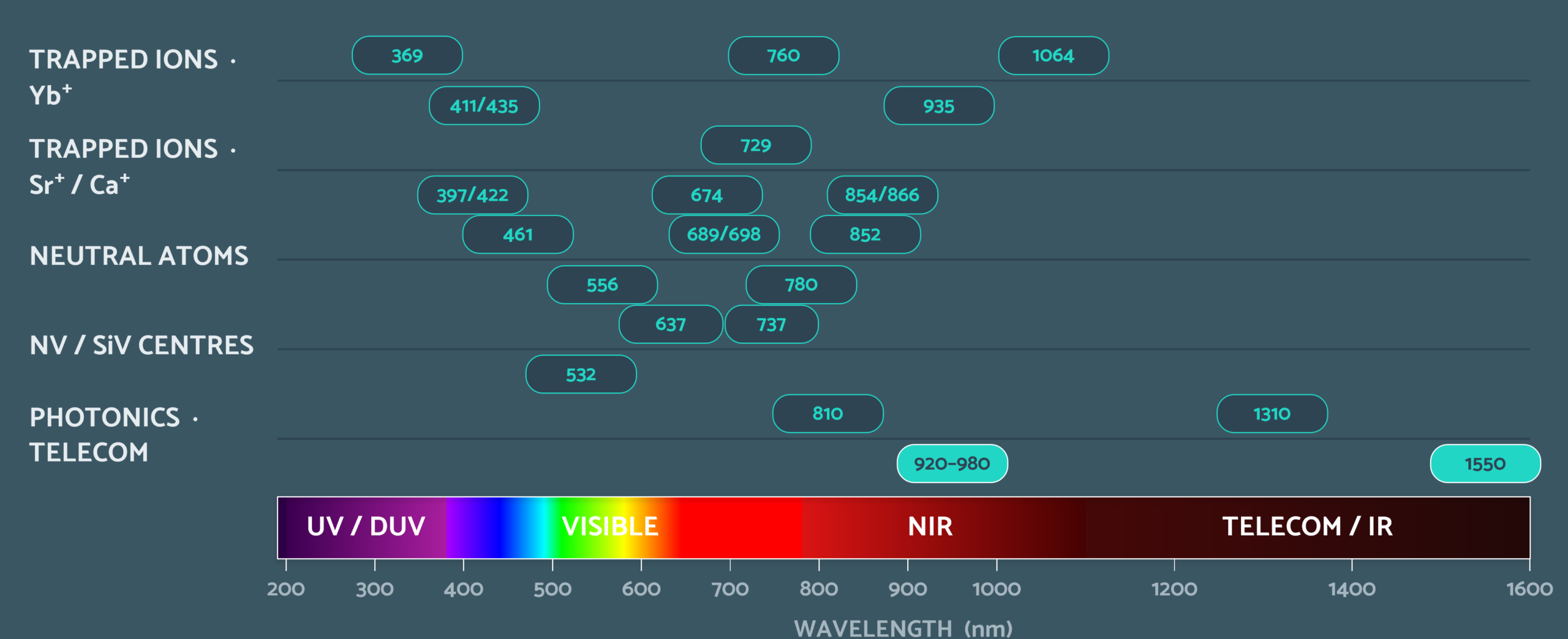
Figure 1. OPTOMAN IBS coating capability across atomic and ionic transition wavelengths, 193 nm to 5000 nm.
Key properties of OPTOMAN IBS coatings relevant to quantum applications:
- Ultra-low absorption (<1 ppm per surface). IBS produces fully densified, void-free coating layers that eliminate absorption-induced heating, which is responsible for frequency shifts and decoherence in optical cavities and atom-trapping systems.
- Near-zero scatter. The bulk-like packing density of IBS coatings preserves the substrate surface roughness, resulting in virtually scatter-free optics. In quantum systems, scattering losses reduce photon coherence and directly degrade cavity finesse.
- High reflectivity (up to 99.995%). Tight control over layer thickness and refractive index enables cavity mirrors with the finesse levels required for strong atom-photon coupling.
- Environmental and thermal stability. The amorphous, pore-free structure of IBS coatings is immune to humidity, temperature fluctuations, and mechanical wear, ensuring that resonance frequencies and spectral performance remain stable throughout the system’s lifetime.
- Batch-to-batch repeatability. Quantum hardware often requires multiple identical optical components within a single system. IBS process stability ensures that spectral performance is reproduced across coating runs, which is critical when integrating optics into scalable multi-qubit or multi-channel platforms.
Design examples
Dichroic short-pass filter — 461/760 nm pass; 532/556 nm reject
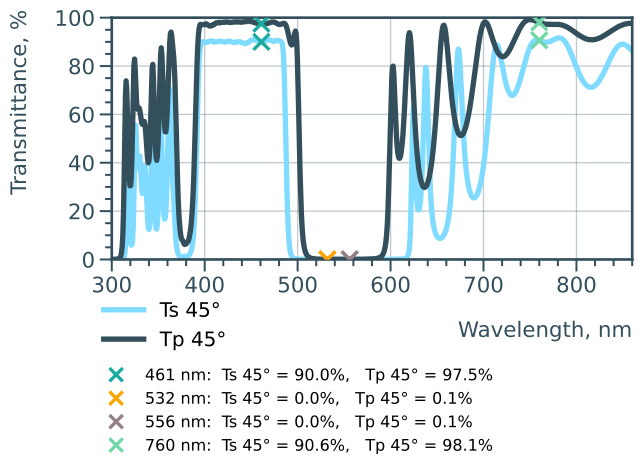
Figure 2. Measured transmittance spectra of OPTOMAN DM501-AR907 coating. |
Coatings (IBS):
|
Telecom Wavelength Brewster Polarizer
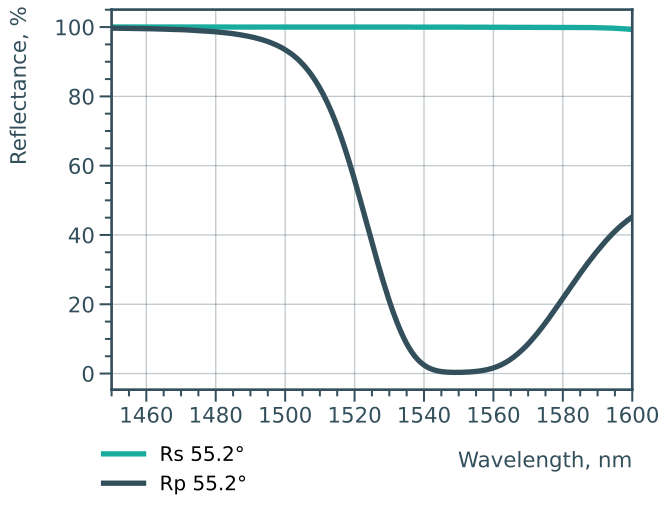
Figure 3. Measured reflectance spectra of OPTOMAN TFP106 coating. |
Coatings (IBS):
|
Laser Mirror for 840-860 nm, AOI=0-45°
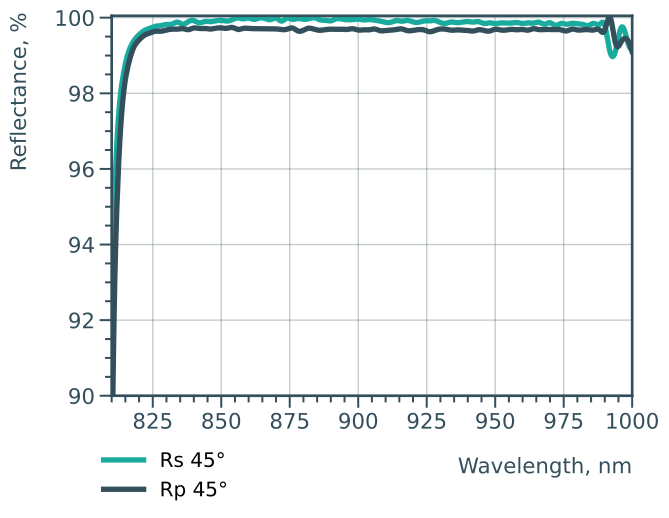
Figure 4. Measured reflectance spectra of OPTOMAN LLM296 coating. |
Coatings (IBS):
|
Controlled high reflectivity mirror, 950 nm, AOI=45°
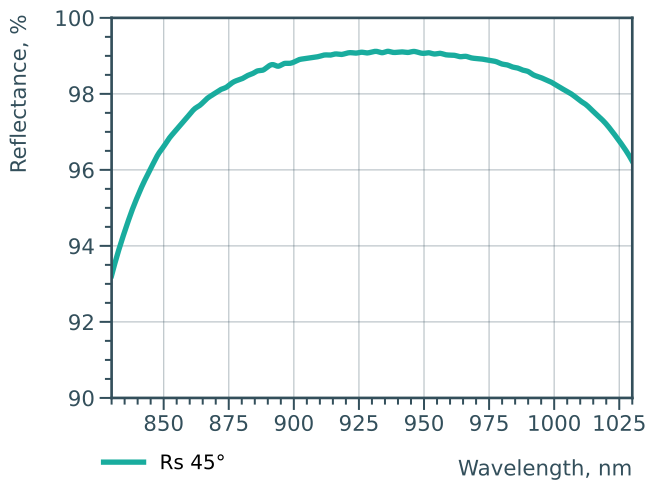
Figure 5. Measured reflectance spectra of OPTOMAN PR298 coating. |
Coatings (IBS):
|
Non-polarizing 1550 nm Beam Splitter
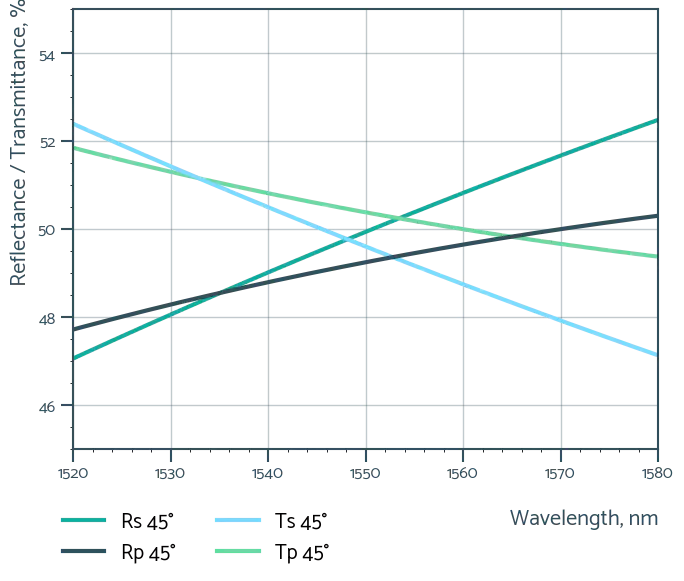
Figure 6. Measured reflectance/transmittance spectra of OPTOMAN NPBS14 coating. |
Coatings (IBS):
|
Ultra-low Loss Measured
Surface absorption in OPTOMAN IBS oxide coatings has been measured at 0.118 ppm per surface at 1064 nm using photothermal common-path interferometry. At this level, cavity finesse scales as 1/total loss, meaning that reducing coating absorption from 5 ppm to sub-ppm levels increases cavity finesse by an order of magnitude. The same measurement program has demonstrated a 5x reduction in absorption relative to standard chirped mirror specifications on the market.
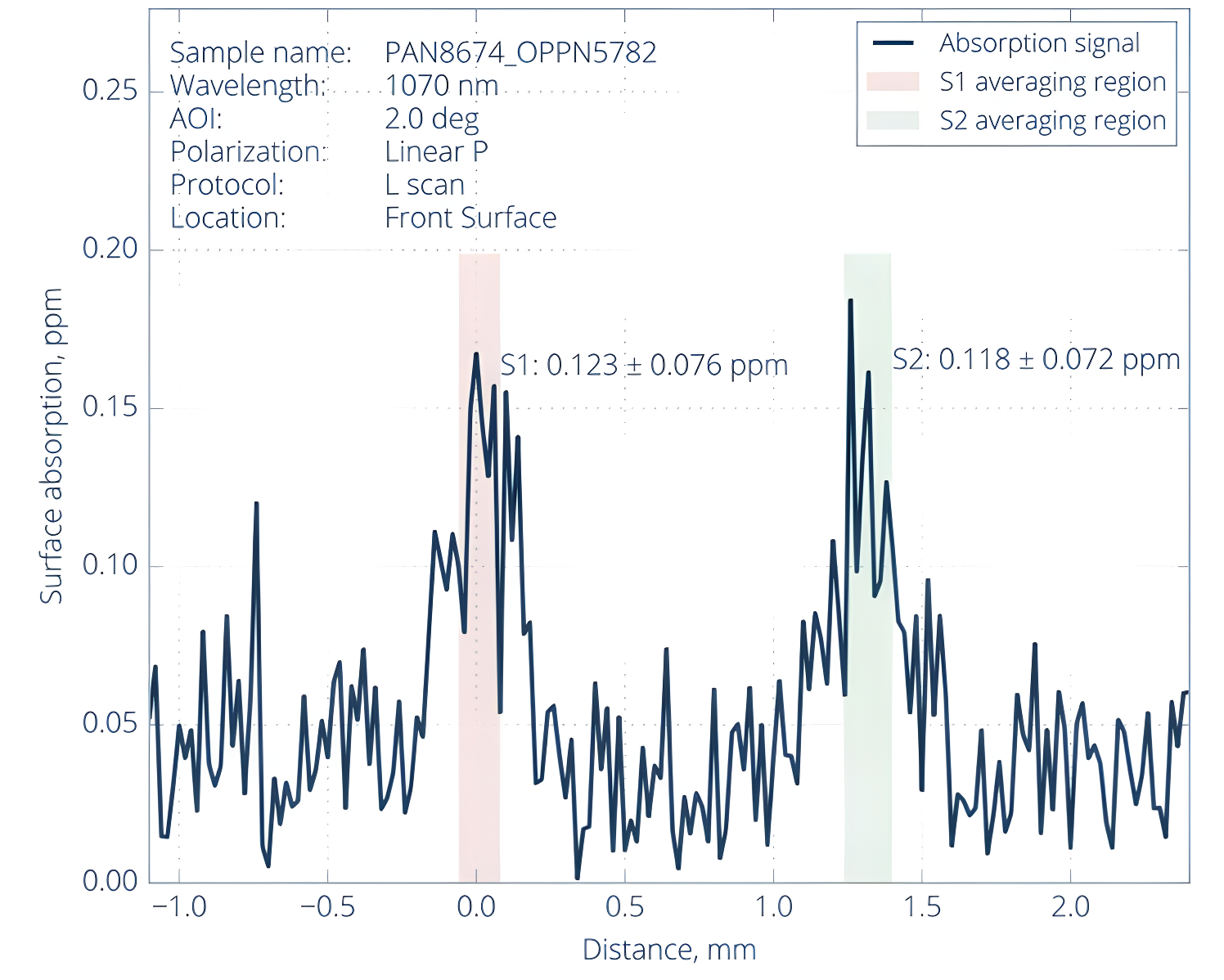 |
Figure 7. Longitudinal absorption scan of OPTOMAN IBS oxide coating at 1070 nm. Surface absorption: 0.118 ppm per surface.
Quantum Applications Optimized Optical Assemblies
Beyond mirrors and filters, complete quantum optical setups rely on polarization control components that must meet the same loss and stability requirements as the rest of the system. OPTOMAN offers both as standard catalog items, manufactured with IBS coatings to ensure consistent retardation, high extinction ratios, and minimal wavefront distortion across demanding quantum applications.
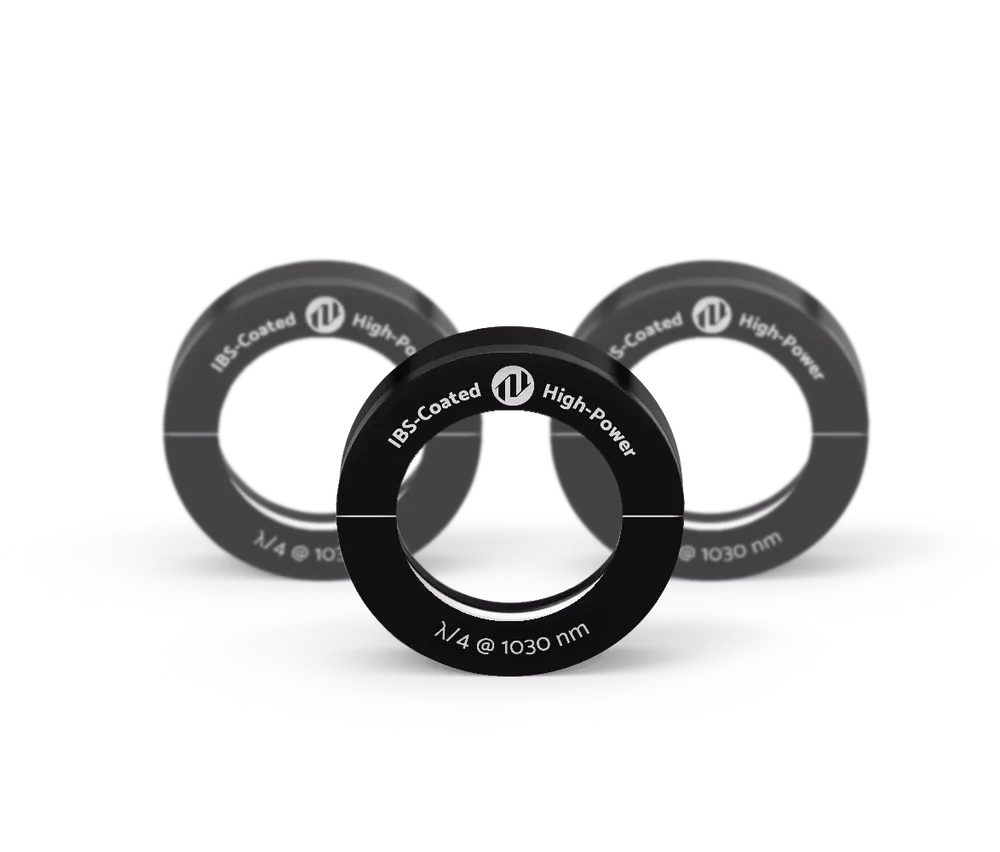 |
IBS Coated New-gen Waveplates
|
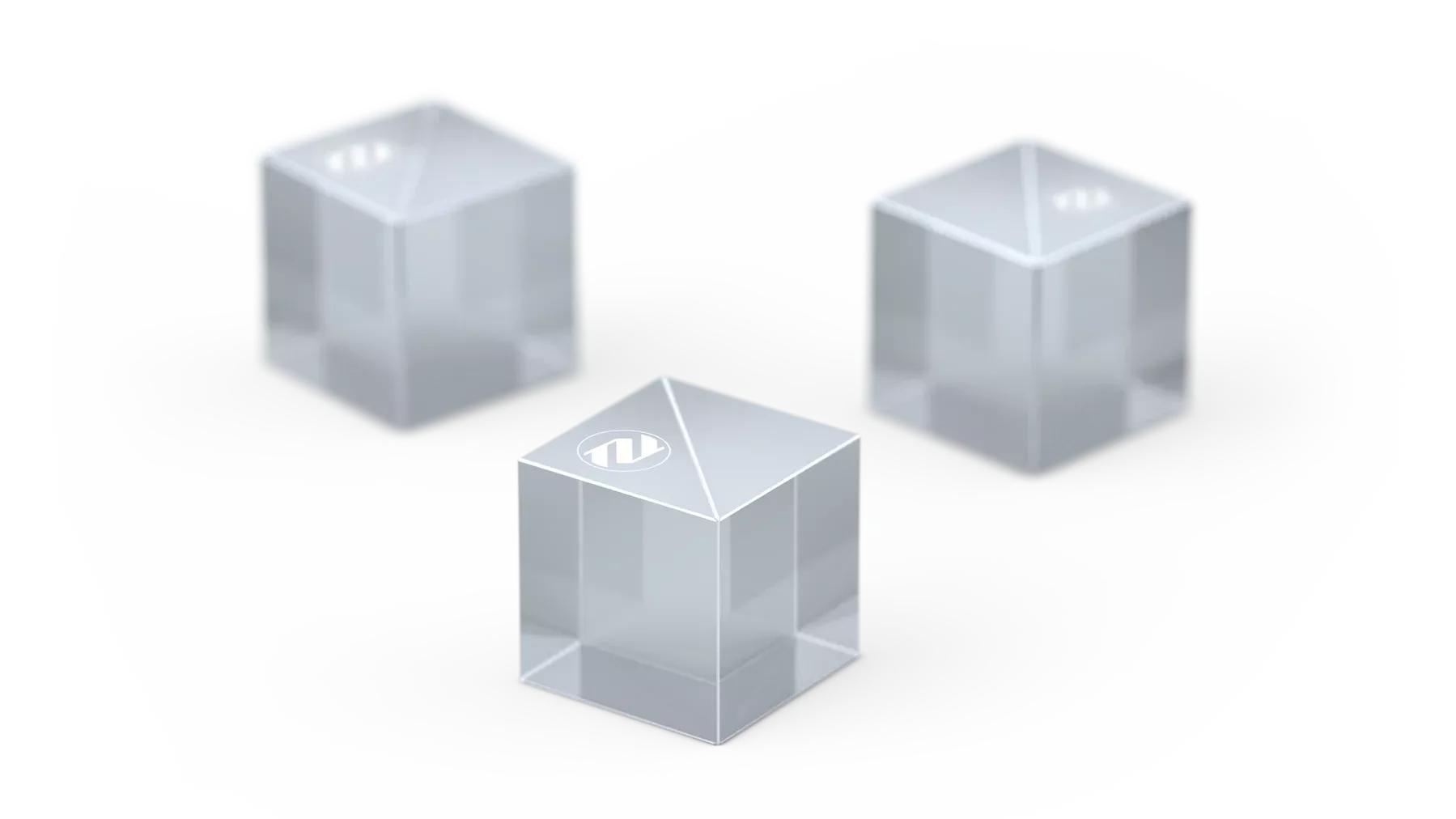 |
Polarizing Cube Beamsplitters
|
Contact OPTOMAN
Reach out to discuss your wavelength requirements, loss budgets, or qualification standards. OPTOMAN designs, manufactures, and delivers precision optics for quantum applications.